What Does a Surgical Technologist Do?
A look at the scrub role inside the operating room: sterile fields, instrument counts, long shifts on your feet, and the credentials employers check.
By Marisol Teague · Oct 26, 2026 · 9 min read
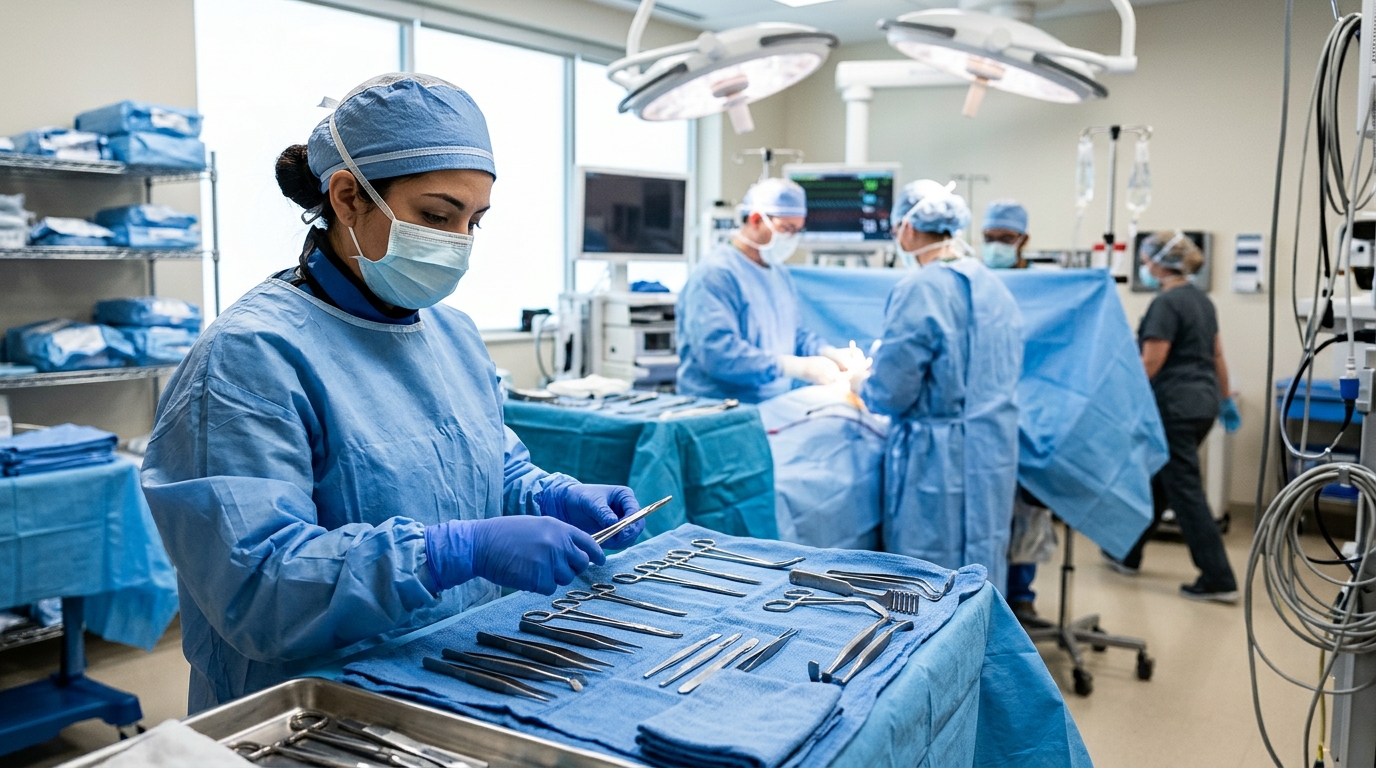
A surgical technologist is the person in scrubs and a sterile gown who sets up the operating room, hands instruments to the surgeon during the procedure, and keeps the sterile field intact from the first incision to the final count. The U.S. Bureau of Labor Statistics (2025) describes the core work as preparing operating rooms, sterilizing equipment, readying patients for surgery, passing instruments, counting supplies, and maintaining sterility.
It is a hands-on, standing, team-based job that you can enter with a certificate or associate's degree from an accredited program rather than a four-year degree, and most jobs are in hospitals.
A Day in the Life
You usually arrive before the first case is scheduled to start. You check the day's schedule and the surgeon's preference card — the list of instruments, sutures, gloves, and supplies that surgeon wants for that specific procedure — then pull a case cart from sterile processing and bring it into the room.
You wipe down surfaces, position the OR table and lights, and open sterile supplies onto the back table without touching the inside of any wrapper. You scrub your hands and forearms, gown and glove, and build your setup: instruments laid out on the back table, the immediate-use instruments on the Mayo stand, sutures loaded, electrosurgical pencil and suction tubing ready to be passed off to the circulator for connection. Before the patient is draped, you and the circulating registered nurse do the initial count — sponges, needles, blades, and instruments — and the number is recorded on the board.
The patient comes in, and you may help with transfer, positioning, and skin prep. Everyone stops for the time-out: patient name, procedure, site, allergies. Then you drape and the case begins.
During the operation you pass sterile instruments and supplies to the surgeon and first assistant, anticipating what comes next rather than waiting to be asked. Depending on the case and your training, you may hold retractors, hold internal organs in place, cut sutures, manage laparoscopic camera and light cords, or set up robotic surgical equipment (U.S. Bureau of Labor Statistics, 2025; O*NET OnLine, U.S. Department of Labor, 2026). You handle specimens carefully and label them with the circulator.
As the surgeon starts closing, you run the closing counts. If a count is off, nothing leaves the room until it is resolved. Afterwards you break down the field, send instruments back for decontamination, help with turnover, and set up for the next case. Shifts can run longer than eight hours, and hospital staff may work or be on call during nights, weekends, and holidays (U.S. Bureau of Labor Statistics, 2025).
Who Thrives in This Career
- If you're good at memorizing sequences, you'll likely enjoy working from surgeon preference cards and anticipating the next instrument before it's requested.
- If you're good at tracking small details under pressure, you'll likely enjoy the sponge, needle, blade, and instrument counts you run with the circulating nurse at the start and close of every case.
- If you're good at following rules exactly, even when nobody is checking, you'll likely enjoy maintaining the sterile field — opening supplies, gowning, and keeping your hands above waist level.
- If you're good at standing still and staying focused for long stretches, you'll likely handle holding retractors and holding internal organs in place during long cases.
- If you're good at speaking up briefly and clearly, you'll likely do well in the surgical time-out and in flagging a broken count or a contaminated glove.
- If you're good with mechanical setups and cables, you'll likely enjoy assembling laparoscopic towers, suction and electrosurgical connections, and setting up robotic surgical equipment.
- If you're good at working fast without cutting corners, you'll likely cope with room turnover between back-to-back cases.
- If you're comfortable around blood, bone, and surgical smoke, you'll find the scrub role far easier to sustain than people who are not.
Salary, Outlook, and Requirements
Pay for this occupation is usually an hourly wage plus shift differentials for nights, weekends, and call, and it varies widely by state, metro area, and employer type. Always check the current published figures rather than relying on a number you saw secondhand.
| Metric | Figure | Source/Year |
|---|---|---|
| Median annual wage, surgical technologists | Published in the national wage data — look up the current figure before you commit to a program | U.S. Bureau of Labor Statistics, May 2025 |
| Median pay, surgical assistants and technologists (combined occupation) | Published in the Occupational Outlook Handbook profile | U.S. Bureau of Labor Statistics, 2025 |
| Typical entry-level education | Postsecondary certificate or associate's degree from an accredited program | U.S. Bureau of Labor Statistics, 2025 |
| Certification | CST exam (NBSTSA); employers may require or prefer certification; some states regulate these workers | U.S. Bureau of Labor Statistics, 2025; NBSTSA |
| Projected job growth | A projected percentage change is published for 2025–35; check the current Handbook figure | U.S. Bureau of Labor Statistics, 2025 |
| Projected annual openings | An average annual openings estimate is published for surgical assistants and technologists | U.S. Bureau of Labor Statistics, 2025 |
| Employment level | A 2025 count of jobs held by surgical technologists is published | U.S. Bureau of Labor Statistics, 2025 |
| Largest employer | Hospitals — state, local, and private | U.S. Bureau of Labor Statistics, 2025 |
| Schedule | Most work full time; hospital staff may work or be on call nights, weekends, and holidays, with shifts longer than 8 hours | U.S. Bureau of Labor Statistics, 2025 |
| Safety | One of the highest rates of injuries and illnesses of all occupations | U.S. Bureau of Labor Statistics, 2025 |
How to Get Started
- Enroll in an accredited surgical technology program. To sit the main certification exam, you generally need to graduate from a program accredited by CAAHEP or ABHES, or complete qualifying military surgical technology training (NBSTSA). Programs award either a certificate or an associate's degree (U.S. Bureau of Labor Statistics, 2025). Confirm the accreditation status in writing before you pay a deposit.
- Complete the clinical requirement. Accredited programs require 120 cases on real patients and 300 to 400 hours of actual operating room experience (NBSTSA). This is where you learn counts, draping, and preference cards on live cases, supervised by staff technologists and surgeons.
- Get CPR or basic life support certification. Many jobs require it alongside the surgical credential (U.S. Bureau of Labor Statistics, 2025). Programs often arrange this, but check.
- Pass a certification exam. The NBSTSA Certified Surgical Technologist (CST) exam is a four-hour computer-based test with 175 multiple-choice questions, 150 of which are scored; you pass with 98 or more correct on the scored items. The content weighting is Perioperative Care 65% (97 items), Ancillary Duties 15% (23 items), and Basic Science 20% (30 items) (NBSTSA). Only a technologist certified by NBSTSA may use the CST title, and the credential is preferred or required by most employers nationwide and required by many states (NBSTSA). An alternative is the Tech in Surgery–Certified (TS-C) credential from the National Center for Competency Testing, whose exam covers medical terminology, asepsis and infection control, pharmacology, OSHA regulations, and surgical knowledge.
- Check your state's rules. Some states regulate surgical technologists (U.S. Bureau of Labor Statistics, 2025). Look up your state health department or licensing board to see whether registration or a specific certification is mandatory where you plan to work.
- Apply for entry-level operating room roles. Target job titles such as surgical technologist, scrub tech, OR technician, and central sterile processing technician, posted on hospital system career portals, outpatient surgery center sites, and staffing agencies that place perioperative staff. Your clinical rotation sites are the most direct channel — ask the OR manager and the preceptor you scrubbed with whether new-graduate positions are opening.
- Plan your specialty. Once hired, many technologists train into service lines such as orthopedics, cardiothoracic, neuro, or robotics, which changes the instrument trays you master and the call schedule you carry.
Frequently asked questions
How long does it take to become a surgical technologist?
It depends on the format you choose. Certificate and diploma programs are shorter than associate's degree programs, which include general education coursework alongside the clinical component. Both must meet the same clinical case and operating room hour requirements to qualify you for certification. Ask each school for its published program length, class schedule, and clinical placement arrangements, since part-time and evening tracks stretch the timeline considerably.
Can military medical training count toward becoming a surgical technologist?
Yes. Alongside graduating from an accredited civilian program, completing a qualifying military surgical technology training program can make you eligible for the NBSTSA certification exam. If you trained in a service branch, gather your training records, course codes, and case documentation early, then confirm directly with the certifying body that your specific program meets its eligibility criteria before you register and pay for the exam.
Where do surgical technologists work besides hospitals?
Hospitals account for the largest share of jobs, but not all of them. Other settings include freestanding outpatient and ambulatory surgery centers, and the offices of physicians and dentists that perform procedures on site. Outpatient settings often run scheduled daytime case lists rather than emergency work, which changes the hours and the mix of procedures you see compared with a large hospital operating suite.
What's the difference between a surgical technologist and a surgical assistant?
Federal data groups them into one occupation, but the roles differ in scope. The technologist works mainly in the scrub role, managing the sterile field, instruments, and counts. The assistant works more directly in the wound under the surgeon's direction, with additional training and a separate credential. Many assistants start as technologists, so the scrub role is a common route into the advanced position.
Is the job physically hard on your body?
It is demanding in specific ways: long periods standing without moving, lifting and positioning patients, carrying heavy instrument trays, wearing lead aprons during imaging cases, and exposure to sharps, body fluids, and surgical smoke. Supportive footwear, compression socks, correct lifting technique, and strict sharps-handling habits matter from your first week. Ask about staffing, break coverage, and call rotation when you interview.
Sources
- U.S. Bureau of Labor Statistics — Surgical Assistants and Technologists : Occupational Outlook Handbook (2025-05)
- O*NET OnLine (U.S. Department of Labor) — 29-2055.00 - Surgical Technologists (2026)

Written by
Marisol Teague
Marisol oversees how Preferred Careers thinks about work itself — not just how to get a job, but why certain ones feel worth keeping. She's drawn to the quiet negotiations people make between ambition and sanity, and edits with an eye for the sentence that gives the game away.