HVAC Technician: Career Overview
From refrigerant recovery and combustion analysis to attic crawlspaces and on-call weekends, here is what the work involves before you commit to it.
By Marisol Teague · Oct 26, 2026 · 9 min read
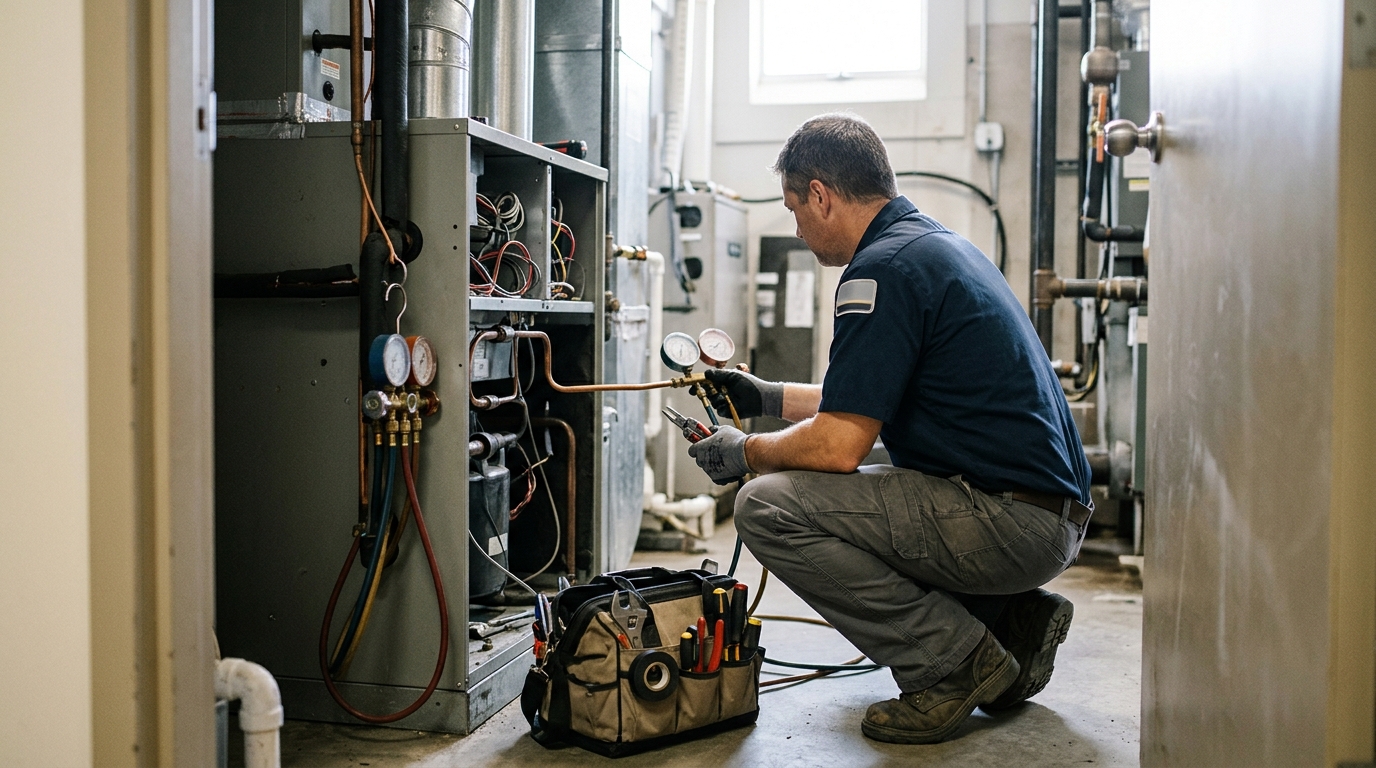
HVAC technicians install, maintain and repair heating, ventilation, air conditioning and refrigeration systems — wiring electrical components, testing equipment, replacing worn parts, explaining malfunctions to customers and keeping records of the work performed (U.S. Bureau of Labor Statistics, 2025). It is hands-on, diagnostic, mostly mobile work, done in attics, basements, mechanical rooms and on rooftops.
Entry runs through a postsecondary HVACR program or an apprenticeship, plus EPA Section 608 refrigerant certification, which nearly every technician needs (U.S. Bureau of Labor Statistics, 2025). Licensing rules sit at the state and local level, so they vary by where you work.
A Day in the Life
A residential service day usually starts at the shop or in your own truck: you check the dispatch board in the company's field service app on a tablet or phone, load parts for the calls you can predict — run capacitors, contactors, condensate pumps, filters, a flame sensor or two — and drive to the first address. A driver's license matters here, because the job is built around travelling to jobsites (U.S. Bureau of Labor Statistics, 2025).
Call one is a no-cooling complaint. You talk to the homeowner about what the system was doing before it quit, then pull the disconnect and open the air handler. Out come the multimeter and clamp meter to check voltage at the contactor, microfarads on the capacitor and amp draw on the compressor. Outside, you hook up a manifold gauge set or digital probes, read suction and liquid pressures, and calculate superheat and subcooling to judge the charge and whether the metering device or TXV is the problem. A leak is confirmed with an electronic leak detector and soap bubbles, so you recover the refrigerant with a recovery machine into a recovery cylinder — the work EPA Section 608 certification exists to cover — braze the repair with nitrogen flowing through the line set, pull a deep vacuum with a vacuum pump and watch a micron gauge before weighing in a new charge on a digital scale.
Afternoon calls shift. A furnace service means a combustion analyzer in the flue, a manometer on the gas valve, inspection of the heat exchanger and a check of flame rectification at the sensor. A commercial stop might be a rooftop unit: belts, economizer dampers, filter changes, static pressure readings and airflow with an anemometer. An install day instead means hanging a condenser pad, running line sets, sealing sheet metal duct, pulling low-voltage thermostat wire and wiring the disconnect. Every visit ends the same way: photos, a written record of what you did, parts used, a recommendation for maintenance, and an invoice or work order closed out in the app.
Schedules are typically full time, with evening, weekend or on-call rotations and overtime when heat waves and cold snaps hit (U.S. Bureau of Labor Statistics, 2025).
Who Thrives in This Career
- If you're good at narrowing a problem down logically, you'll likely enjoy the diagnostic part of this job — reading superheat and subcooling off the gauges to decide whether the fault is charge, airflow or the metering device.
- If you're good at working with electricity safely, you'll likely enjoy the electrical side — metering a contactor, testing a capacitor and installing components and wiring on a new system.
- If you're good at explaining technical things in plain language, you'll likely enjoy the customer-facing part — telling a homeowner what the cracked heat exchanger means and why you're recommending a maintenance schedule.
- If you're good at tolerating physical discomfort, you'll likely cope with the conditions — attic work in August, rooftop units in wind, and crawlspaces with a flashlight in your teeth.
- If you're good at precise manual work, you'll likely enjoy brazing line sets with nitrogen flowing and pulling a system down to a clean micron reading before charging it.
- If you're good at keeping records straight, you'll likely handle the paperwork well — logging work performed, parts replaced and readings taken on every call.
- If you're good at adapting your plan mid-shift, you'll likely handle dispatch reality — a no-heat emergency added at 4pm that pushes the rest of the board back.
- If you're good at studying technical material on your own, you'll likely get through the EPA Section 608 exam and later certification tests without stalling.
Salary, Outlook, and Requirements
The figures below are published and updated by the sources named; look them up directly rather than relying on a number copied into an article.
| Metric | Figure | Source/Year |
|---|---|---|
| Median annual wage | Published for heating, air conditioning and refrigeration mechanics and installers — check the current figure in the Occupational Outlook Handbook profile | U.S. Bureau of Labor Statistics, 2025 |
| Typical entry-level education | Listed in the "How to Become One" section of the occupation's OOH profile | U.S. Bureau of Labor Statistics, 2025 |
| Projected employment growth, 2025-35 | Percentage published in the OOH "Job Outlook" tab | U.S. Bureau of Labor Statistics, 2025 |
| Projected average annual job openings over the decade | Published alongside the growth projection | U.S. Bureau of Labor Statistics, 2025 |
| Number of jobs held in the occupation | Published in the OOH summary table | U.S. Bureau of Labor Statistics, 2025 |
| Largest employing industry | Plumbing, heating and air-conditioning contractors employ a large share | U.S. Bureau of Labor Statistics, 2025 |
| Workplace injury and illness rate | Reported for this occupation relative to other occupations | U.S. Bureau of Labor Statistics, 2025 |
| Refrigerant certification | EPA Section 608 certification required for nearly all technicians | U.S. Bureau of Labor Statistics, 2025 |
| Preparation level | O*NET Job Zone classification and Specific Vocational Preparation (SVP) range published for the occupation | O*NET OnLine, U.S. Department of Labor, 2026 |
Pay structure varies: many employers pay hourly with overtime, some service companies add commission or spiff on equipment sales and maintenance agreements, and on-call rotations may carry extra pay. State-level wage data for your own metro area is published separately by the Bureau of Labor Statistics.
How to Get Started
- Finish high school or an equivalent, and take shop, math and physics if offered. These feed directly into duct sizing, electrical calculations and pressure-temperature work.
- Enrol in a postsecondary HVACR program or an apprenticeship. Programs run at community colleges and trade schools, and the Bureau of Labor Statistics (2025) describes their typical length and the certificate or degree they lead to. Apprenticeships combine paid on-the-job hours with classroom instruction; look for sponsors through local union halls, contractor associations and your state apprenticeship agency.
- Pass the EPA Section 608 exam. Section 608 of the federal Clean Air Act requires certification for anyone who maintains, services, repairs or disposes of appliances containing ozone-depleting refrigerants, with four types — Type I, Type II, Type III and Universal (ESCO Institute, undated). Exams are offered by approved certifying organisations such as the ESCO Institute. The certification does not expire and does not need renewal (ESCO Institute, undated). Apprentices are exempt only while closely and continually supervised by a certified technician (CourseCareers, citing EPA, undated).
- Get and keep a valid driver's license. Technicians commonly need one to travel to jobsites (U.S. Bureau of Labor Statistics, 2025), and service companies will check your record before handing over a truck.
- Apply for entry-level roles under the titles employers actually post. O*NET (2026) lists AC Mechanic, HVAC Installer, HVAC Service Tech and Refrigeration Technician among reported job titles. Installer and installer-helper roles are the usual way in. Apply directly to plumbing, heating and air-conditioning contractors, which employ a large share of the workforce (U.S. Bureau of Labor Statistics, 2025), and to school districts, hospitals and property management firms that run in-house maintenance crews.
- Check whether your state or locality requires a license. Some do; the Bureau of Labor Statistics (2025) directs people to their state or locality, or to CareerOneStop, to confirm requirements. Rules differ by state and sometimes by city or county, so check before you assume.
- Add a voluntary credential once you have field time. NATE certification is awarded to HVAC technicians by North American Technician Excellence on the basis of a knowledge exam (Trane Technologies, undated), and many employers use it to sort service technicians from installers.
Frequently asked questions
What is the difference between HVAC installation and service work?
Installation crews put in new equipment: setting condensers, running line sets, fabricating and sealing duct, pulling thermostat wire and making the electrical connections. It is heavier, more repetitive and more schedulable. Service work is diagnostic and unpredictable — you arrive at a broken system with a gauge set and a meter and have to find the fault. Many technicians start on install and move to service once they can troubleshoot confidently.
How dangerous is HVAC work?
The Bureau of Labor Statistics (2025) reports an injury and illness rate for this occupation measured against other occupations. The hazards are concrete: electrical shock at live contactors and disconnects, burns from brazing torches and hot flue components, frostbite risk from liquid refrigerant, muscle strains from lifting compressors and sheet metal, and cuts from duct edges. Employers supply lockout/tagout procedures, gloves, eye protection and ladder training, and using them consistently is the whole job.
Do HVAC technicians have to sell to customers?
Discussing malfunctions with customers and recommending maintenance are part of the recognised duties (U.S. Bureau of Labor Statistics, 2025). At many residential service companies that extends further — presenting repair-versus-replace options, quoting equipment, offering maintenance agreements. How much selling you do depends heavily on the employer: commercial maintenance contracts and in-house facility roles involve far less than residential retail service. Ask about it in the interview, because it shapes the day considerably.
Where can an HVAC career lead after a few years in the field?
Common directions include commercial refrigeration, building automation and controls, boilers and hydronics, or specialising in a manufacturer's equipment line. Off the truck, experienced technicians move into service dispatch, estimating, project management, field supervision, training and inspection, or start their own contracting business — which in licensing states usually means meeting a contractor licensing requirement separate from any technician credential.
Sources
- U.S. Bureau of Labor Statistics — Heating, Air Conditioning, and Refrigeration Mechanics and Installers: Occupational Outlook Handbook (2025)
- O*NET OnLine (U.S. Department of Labor) — 49-9021.00 - Heating, Air Conditioning, and Refrigeration Mechanics and Installers (2026)

Written by
Marisol Teague
Marisol oversees how Preferred Careers thinks about work itself — not just how to get a job, but why certain ones feel worth keeping. She's drawn to the quiet negotiations people make between ambition and sanity, and edits with an eye for the sentence that gives the game away.