Veterinary Technician or Veterinarian? How to Choose
One path takes two years of college and a 170-question exam; the other takes a doctorate and the NAVLE — here's how the daily work differs too.
By Harlan Voss · Oct 26, 2026 · 9 min read
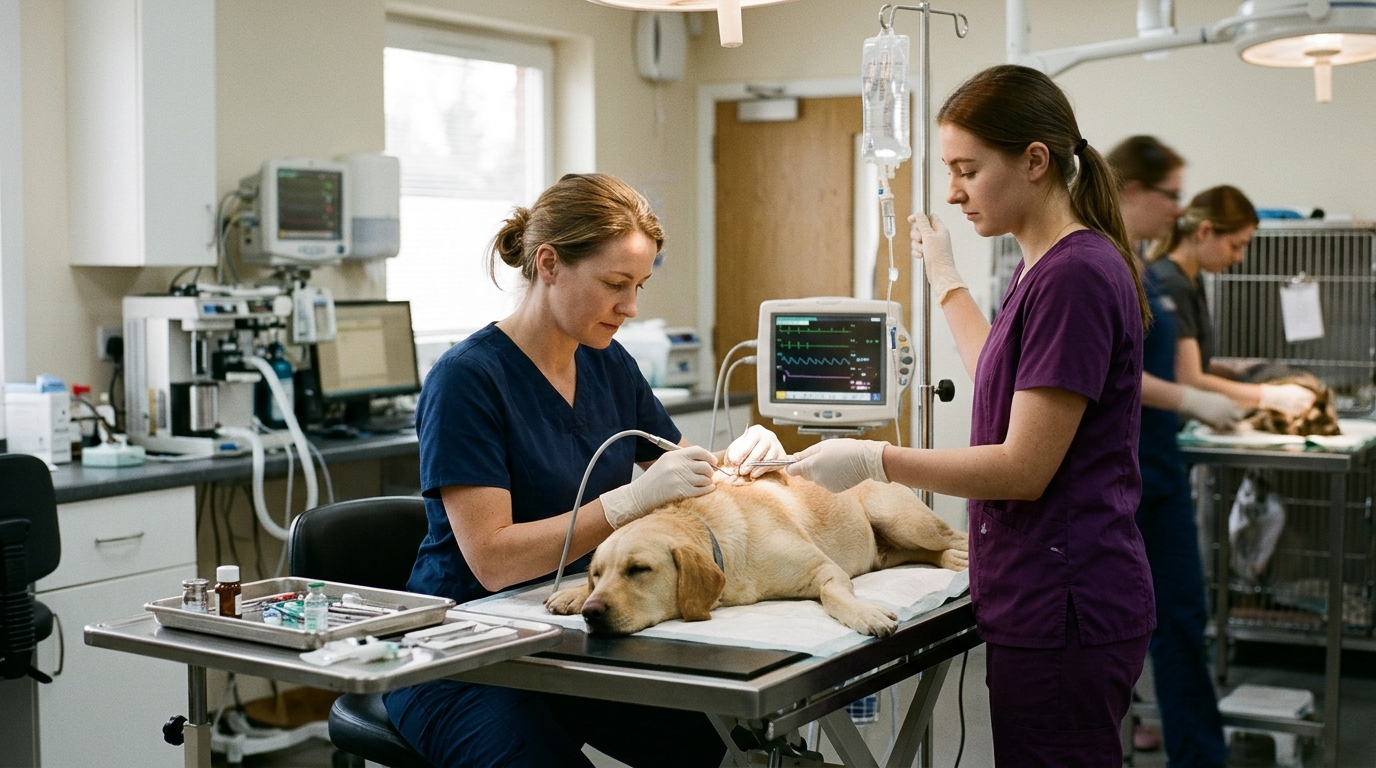
Veterinary technicians and veterinarians work the same exam rooms and the same surgical suites, but they are separated by what each is licensed to do: the veterinarian diagnoses, prescribes and operates, while the technician runs the diagnostics, prepares and monitors the patient, and carries out treatment orders. The pay gap reflects that split — a median of $47,380 a year for veterinary technologists and technicians against $130,100 for veterinarians (U.S. Bureau of Labor Statistics, May 2025) — as does the schooling, which is roughly two years and a credentialing exam versus a four-year Doctor of Veterinary Medicine plus licensure.
This guide compares the two on pay, hours, education, physical risk and advancement ceiling, then sets out the situations in which each one is the right call.
The Core Difference
The veterinarian decides what is wrong with the animal and what will be done about it; the veterinary technician performs most of the hands-on work that decision requires, from the blood draw to the anesthetic monitoring to the discharge instructions.
In practical terms, a credentialed technician's shift is built around procedures and equipment. You place IV catheters, draw blood and tissue samples, run them on in-house hematology and chemistry analyzers, prepare and administer vaccines, position patients for digital radiographs, induce and monitor anesthesia using a pulse oximeter and capnograph, scale and polish teeth under a dental unit, and assist the veterinarian during surgery (O*NET OnLine, U.S. Department of Labor). You also live in the practice management software — entering treatment sheets, logging controlled drugs, and chasing lab results.
The veterinarian's shift is built around decisions. You diagnose, treat and research diseases and injuries of animals, whether that means companion-animal practice, livestock inspection or laboratory research (O*NET OnLine, U.S. Department of Labor). You read the radiographs and the cytology the technician produced, write the prescription, perform the surgery, deliver the prognosis to the owner, and carry the legal responsibility for the outcome. Diagnosis, prognosis, prescribing and surgery are reserved to licensed veterinarians under each state's veterinary practice act, which is also what sets how closely a technician must be supervised — directly, indirectly, or immediately — and those definitions differ from state to state.
The overlap runs one way. A veterinarian on an overnight emergency shift will place her own catheter and spin her own blood smear. A technician cannot cross the line into diagnosis or prescribing no matter how many years of experience sits behind her. If the part of the work you want is the judgment call, the technician credential will eventually feel like a ceiling rather than a job.
One more structural difference: there are far more technician roles than veterinarian roles. The Bureau of Labor Statistics projects about 13,400 annual openings for veterinary technologists and technicians and about 3,100 for veterinarians, each on average over 2025 to 2035.
Side-by-Side Comparison
Both occupations are projected to grow 9 percent from 2025 to 2035 (U.S. Bureau of Labor Statistics, 2025), so the choice between them is not a bet on which field survives. It is a trade of years of schooling and debt against pay and scope.
| Criterion | Veterinary technologist / technician | Veterinarian |
|---|---|---|
| Median annual wage | $47,380, or $22.78 an hour (U.S. Bureau of Labor Statistics, May 2025) | $130,100, or $62.55 an hour (U.S. Bureau of Labor Statistics, May 2025) |
| Pay spread | Lowest 10 percent under $35,710; highest 10 percent over $63,180 (U.S. Bureau of Labor Statistics, May 2025) | Lowest 10 percent under $73,920; highest 10 percent over $215,700 (U.S. Bureau of Labor Statistics, May 2025) |
| Typical schedule | May include evenings, weekends and holidays, especially in emergency and 24-hour hospitals (U.S. Bureau of Labor Statistics, 2025) | Most work full time and often more than 40 hours a week; some work nights or weekends and respond to emergencies outside scheduled hours (U.S. Bureau of Labor Statistics, 2025) |
| Education | Two-year associate degree for technicians; four-year bachelor's degree for technologists (U.S. Bureau of Labor Statistics, 2025), generally from a program accredited by the AVMA Committee on Veterinary Technician Education and Activities (CVTEA) | Doctor of Veterinary Medicine (DVM) or VMD from an accredited veterinary college, generally four years, after undergraduate prerequisite coursework (U.S. Bureau of Labor Statistics, 2025) |
| Credentialing exam | Veterinary Technician National Exam (VTNE), administered by the American Association of Veterinary State Boards: 170 multiple-choice questions (150 scored), three-hour limit, passing scaled score 425 on a 200–800 scale | North American Veterinary Licensing Examination (NAVLE): 360 clinically relevant multiple-choice questions, required for licensure in all US and Canadian licensing jurisdictions |
| Licensure | Must typically pass a credentialing exam and become registered, licensed or certified — RVT, CVT or LVT — with the specific requirement set by the state (U.S. Bureau of Labor Statistics, 2025) | Must be licensed in every state: an accredited program plus a qualifying exam, and most states add a state licensing exam (U.S. Bureau of Labor Statistics, 2025) |
| Physical demands and risk | One of the highest rates of injuries and illnesses of all occupations, including bites, scratches and kicks (U.S. Bureau of Labor Statistics, 2025) | Risk of bites, kicks and scratches from frightened or injured animals, plus infection risk from diseased animals (U.S. Bureau of Labor Statistics, 2025) |
| Advancement ceiling | Lead or head technician, surgical or anesthesia lead, practice manager, instructor in a CVTEA-accredited program, or industry roles; cannot diagnose, prescribe or perform surgery; top-decile pay above $63,180 (U.S. Bureau of Labor Statistics, May 2025) | Post-DVM internship and residency toward board certification, practice ownership, research, regulatory and livestock inspection work; top-decile pay above $215,700 (U.S. Bureau of Labor Statistics, May 2025) |
| Annual openings projected | About 13,400 a year on average, 2025–2035 (U.S. Bureau of Labor Statistics) | About 3,100 a year on average, 2025–2035 (U.S. Bureau of Labor Statistics) |
Two cautions when you read the wage rows. Medians are national and lump together every setting and region, so emergency, specialty, research and rural mixed practice all sit inside the same number — check current figures for your state and metro area on the BLS Occupational Employment and Wage Statistics pages before you plan around them. And the technician wage rows do not distinguish credentialed from uncredentialed staff, which matters in states where the title is not protected.
Who Should Choose Which
Choose veterinary technician or technologist if:
- Choose this if you've already worked a veterinary assistant, kennel or animal care attendant shift and found that restraint, catheter placement, blood draws and anesthesia monitoring held your attention better than the owner conversation in the exam room.
- Choose this if you've already mapped out what debt you are willing to carry and want to be earning a credentialed wage after a two-year associate degree and the VTNE rather than financing a doctorate.
- Choose this if you've already sat through a four-year science track and found you learn faster with your hands — running a blood smear, packing a surgical pack, reading a capnograph trace — than through lecture-and-exam coursework.
- Choose this if you've already got geographic or family constraints that rule out relocating, since CVTEA-accredited veterinary technology programs, including distance-format ones with arranged clinical sites, are far more widely available than accredited veterinary colleges.
Choose veterinarian if:
- Choose this if you've already shadowed in practice and caught yourself wanting to know why one treatment plan was chosen over another, and found the differential diagnosis more interesting than the procedure itself.
- Choose this if you've already completed, or can realistically complete, the undergraduate prerequisite sequence — organic chemistry, biochemistry, physics, biology — at the grade level competitive DVM applicants carry, and can absorb four more years of full-time study afterwards.
- Choose this if you've already credentialed as an RVT, CVT or LVT and keep running into the limits of your state practice act, because scope, not seniority, is what stops you.
- Choose this if you've already decided you want livestock inspection, regulatory work, laboratory animal medicine, research or practice ownership (O*NET OnLine, U.S. Department of Labor) — paths that require the DVM or VMD and a state license, not a technician credential.
Frequently asked questions
Can I credential as a technician first and apply to veterinary school later?
Yes, and plenty of people do. Be aware that veterinary technology coursework often does not substitute for DVM prerequisites such as organic chemistry, biochemistry and physics, so budget for extra undergraduate science before you apply. Your documented clinical hours strengthen an application, and some students keep working weekend technician shifts through the early didactic years. Check each veterinary college's prerequisite list directly, since they differ.
What if my state lets me work as a technician without credentialing?
Some jurisdictions allow on-the-job training or alternate routes to sit for the VTNE, and some let uncredentialed staff do technician-adjacent work under the title veterinary assistant. The titles RVT, CVT and LVT are protected by state law, and credentialing moves with you more easily if you relocate. Your state veterinary board publishes the current rule, including which supervision level applies to each task.
Is there a part-time or work-while-you-study version of either path?
Technician programs are the realistic option here: accredited programs include part-time and distance formats with clinical hours arranged at an approved practice, so you can often credential while employed as a veterinary assistant. Veterinary colleges run full-time, on-campus and end in year-long clinical rotations with hospital call; there is no part-time track. If staying in your current job and location matters, credential first and reassess.
How do I test the work before I commit to either program?
Apply for posted veterinary assistant, kennel attendant or animal care attendant roles at general practices, emergency hospitals and shelters, or ask a practice manager directly about a shadowing day. Ask to be present for anesthesia monitoring, a dental procedure and a euthanasia appointment. Most veterinary colleges require documented veterinary experience hours signed off by a supervising veterinarian anyway, so the hours count twice.
Sources
- U.S. Bureau of Labor Statistics — Veterinary Technologists and Technicians : Occupational Outlook Handbook (2025-05)
- U.S. Bureau of Labor Statistics — Veterinarians : Occupational Outlook Handbook (2025-05)

Written by
Harlan Voss
Harlan covers the business of job-seeking itself — the coaches, platforms, and advice industries that have grown up around finding work. He writes with a skeptic's patience and a soft spot for anyone still trying.