How to Become a Solar Panel Installer
Rooftop PV work rewards comfort at height, torque-spec precision and NEC literacy — here's what crews expect on day one and which credentials move you up.
By Marisol Teague · Oct 26, 2026 · 8 min read
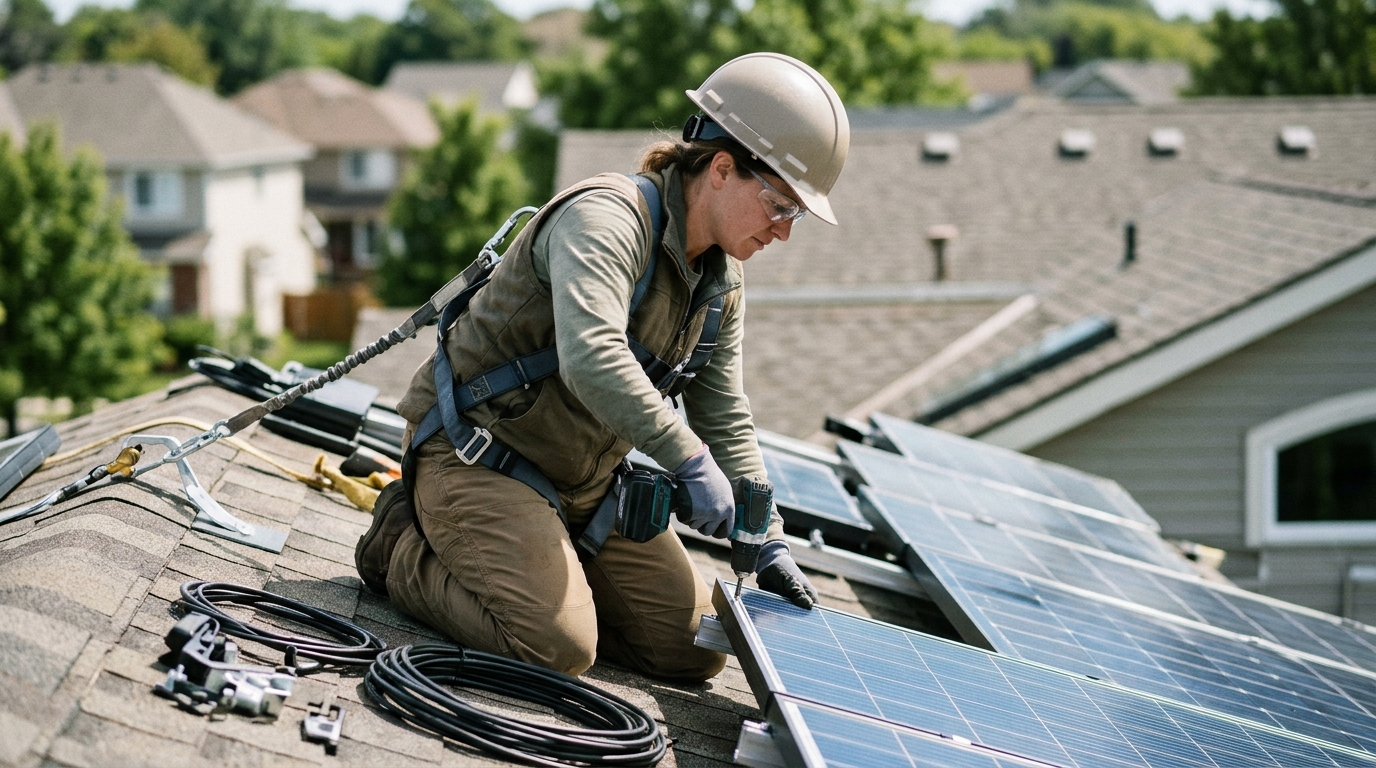
Becoming a solar panel installer usually takes months, not years: most people start as an installer helper with a high school diploma or GED, an OSHA 10-Hour Construction card and a driver's licence, then learn racking, flashing and DC wiring on the job. Certification through NABCEP and, in some states, an electrical licence are what separate a helper from a lead installer or crew foreman.
The work is outdoor construction at height, in heat and cold, carrying 40-60 pound modules up a ladder. Whether it suits you depends less on interest in clean energy than on whether you are steady on a roof and precise with a torque wrench.
Step-by-Step Path
- Finish high school or earn a GED (varies; plan on completing it before applying). Most residential solar contractors list a diploma or GED as a minimum. The useful coursework is geometry and basic algebra — you will calculate roof pitch, rafter spacing, rise over run, and voltage drop on DC home runs. Shop class, roofing or framing experience counts for more than science grades.
- Get your safety cards (1-3 days). An OSHA 10-Hour Construction card is the common baseline; some commercial employers want OSHA 30. Add a fall-protection course covering harnesses, anchor points and roof-edge warning lines, plus CPR and First Aid through a recognised provider. These are short, inexpensive and often the thing that gets your application read.
- Take an entry-level photovoltaic course (4-12 weeks). Community college certificate programmes, union pre-apprenticeship training and IREC-accredited providers all offer 40-100 hour PV fundamentals courses covering NEC Article 690, array layout, grounding and bonding, and rapid shutdown requirements. Finish by sitting the NABCEP PV Associate exam — an entry-level knowledge credential, not a licence, but it signals you already understand series strings and module-level power electronics.
- Hire on as an installer helper, apprentice installer or solar laborer (first 3-12 months). You will stage modules, carry racking rail, set flashings and lag bolts into rafters, run MC4 connectors, and learn torque specs. Pay in this trade is almost always hourly with overtime during long summer days; some companies add production bonuses tied to systems or kilowatts completed, and union shops use negotiated wage scales. Check current figures for "Solar Photovoltaic Installers" (SOC 47-2231) on the BLS Occupational Employment and Wage Statistics pages and your state labor department before you negotiate.
- Add equipment and manufacturer credentials (ongoing, months 6-18). Get signed off on scissor lifts and boom lifts, forklift operation under OSHA 1910.178 if you do commercial work, and attend the inverter, optimiser and racking training your employer's suppliers provide. Learn the monitoring portals crews use for commissioning and the clamp meter, insulation tester and irradiance meter used for troubleshooting.
- Document your installations and sit the NABCEP PV Installation Professional (PVIP) Board Certification (typically year 2 onward). NABCEP requires qualifying installation experience and advanced training hours before you can take the exam, which tests NEC compliance, system design, mechanical integration and commissioning. Many employers pay the fee and give a raise or title bump for passing.
- Decide between crew leadership and the electrical licence track (years 2-5). Crew lead and foreman roles mean running a two- to five-person crew, managing the day's array layout, final torque checks and inspector walk-throughs. The alternative is a registered electrical apprenticeship — commonly four to five years and several thousand on-the-job hours plus classroom instruction — ending in a journeyman electrician licence issued by your state board. Rules on who may terminate AC conductors vary by state, and in some jurisdictions a licensed electrician must perform or supervise that work.
- Move into specialist or contractor roles (years 5+). Common exits are service technician (diagnosing underperforming strings and failed microinverters), QA or field inspector, project manager, estimator, or holding a contractor licence yourself — California, for example, issues a C-46 solar and a C-10 electrical classification through its contractors board. Every state writes its own licensing rules, so check your own board rather than assuming.
How Long It Takes
These stages assume you are starting with no construction background and working full time. Someone coming from roofing, framing or electrical work routinely compresses the first two stages.
| Stage | Milestone |
|---|---|
| Weeks 0-8 | Diploma or GED in hand, OSHA 10-Hour Construction card, fall protection, CPR/First Aid; applications in with residential and commercial installers. |
| Months 2-6 | PV fundamentals course completed and, if you choose, the NABCEP PV Associate exam passed. Hired as installer helper or apprentice installer. |
| Months 3-12 | You can set flashings and rail to spec, land modules, torque hardware, run EMT and land DC home runs under supervision. You are a productive crew member rather than a carrier. |
| Years 1-2 | Lift and equipment sign-offs complete, manufacturer training done, commissioning and monitoring setup handled solo. Title often moves to installer or senior installer. |
| Years 2-4 | Enough documented installations to pursue NABCEP PVIP Board Certification; promotion to lead installer or crew foreman running a crew and handling inspection walk-throughs. |
| Years 4-6 | If you entered a registered electrical apprenticeship around year 1-2, you complete the required on-the-job hours and classroom instruction and sit your state's journeyman electrician exam. |
| Years 6+ | Service technician, QA inspector, project manager, estimator, or a state contractor licence if you want your own crews. |
Seasonality affects all of this. In northern states, residential install volume drops in deep winter and some crews are cut back, which can stretch the hours you need to accumulate. In the Southwest and Southeast, year-round work is more common.
Before You Start
Work through this list before you send applications. Every item is something you can show a hiring foreman.
- Valid driver's licence and a clean motor vehicle record. Crews drive company trucks and trailers; a poor MVR can disqualify you at the insurance stage regardless of your skills.
- A copy of your high school diploma or GED certificate, scanned and ready to attach.
- OSHA 10-Hour Construction card (OSHA 30 if you are targeting commercial or utility-scale work), plus a current CPR and First Aid card.
- Documented fall-protection training and your own fitted full-body harness if you own one. Be honest with yourself about heights: if a steep composition-shingle roof at two storeys bothers you, this is not the trade.
- A basic hand tool kit and PPE: cordless impact driver, adjustable torque wrench, tool belt, chalk line, stud or rafter finder, steel-toed boots, hard hat, safety glasses, work gloves.
- A short refresher on practical math and electrical basics: Ohm's law, series versus parallel strings, roof pitch and rise over run, and a read-through of NEC Article 690. You will be asked about at least one of these.
- A one-page résumé that lists physical and construction tasks explicitly — lifting weight, ladder work, roofing, framing, warehouse, landscaping, military field work — rather than generic duties.
- Awareness of the hiring process: most installers run pre-employment drug screens and background checks, and many ask you to demonstrate lifting a 40-60 pound module and climbing a ladder with it.
Frequently asked questions
How much does the training cost, and do I have to pay for it myself?
OSHA 10 and CPR courses are low-cost and often online. A community college PV certificate is the bigger expense, though many are eligible for state workforce grants or WIOA funding through your local American Job Center. Plenty of installers skip paid training entirely and learn on the job. Union pre-apprenticeship and registered apprenticeship routes typically pay you while you train rather than charging tuition.
Can I get hired with no construction experience at all?
Yes — helper and laborer roles are designed for it, and crews would rather teach their own methods than retrain bad habits. What hiring managers screen for is reliability, a driving record that passes insurance, and physical readiness for ladders and heat. Warehouse, landscaping, moving, agricultural and military experience all read as relevant. Say in your application that you are comfortable working at height, and mean it.
Is there an age limit, and how long can you physically do this work?
There is no upper age limit, and people enter the trade in their thirties and forties regularly. The real constraint is knees, back and shoulders after years of ladder carries and kneeling on hot roofs. That is why many installers aim for lead, service technician, inspector or estimator roles by their thirties or forties — the trade knowledge keeps its value when the roof work stops.
Do I need an electrician's licence to install solar panels?
It depends entirely on your state and sometimes your local jurisdiction. Some states allow non-licensed workers to perform mechanical mounting and DC work under a licensed contractor; others restrict any conductor terminations to licensed electricians. Check your state electrical board and contractor licensing board directly before you plan a route — licensing questions are the one area where guessing wastes years.
How does this compare with becoming a residential electrician?
Entry is faster: solar installer helper roles need weeks of safety training, while a journeyman electrician licence typically requires four to five years of registered apprenticeship plus a state exam. Electricians generally have broader year-round work and higher licensed wage scales. Solar work is more weather-dependent and more repetitive, with more time at height and more module lifting. Compare current wage data for both occupations on BLS OES pages.

Written by
Marisol Teague
Marisol oversees how Preferred Careers thinks about work itself — not just how to get a job, but why certain ones feel worth keeping. She's drawn to the quiet negotiations people make between ambition and sanity, and edits with an eye for the sentence that gives the game away.