A Day in the Life of a Veterinary Technician
From the 7:00 a.m. treatment board to the last discharge call, here is how the hours actually break down in a general practice animal hospital.
By Priya Nandakumar · Oct 28, 2026 · 9 min read
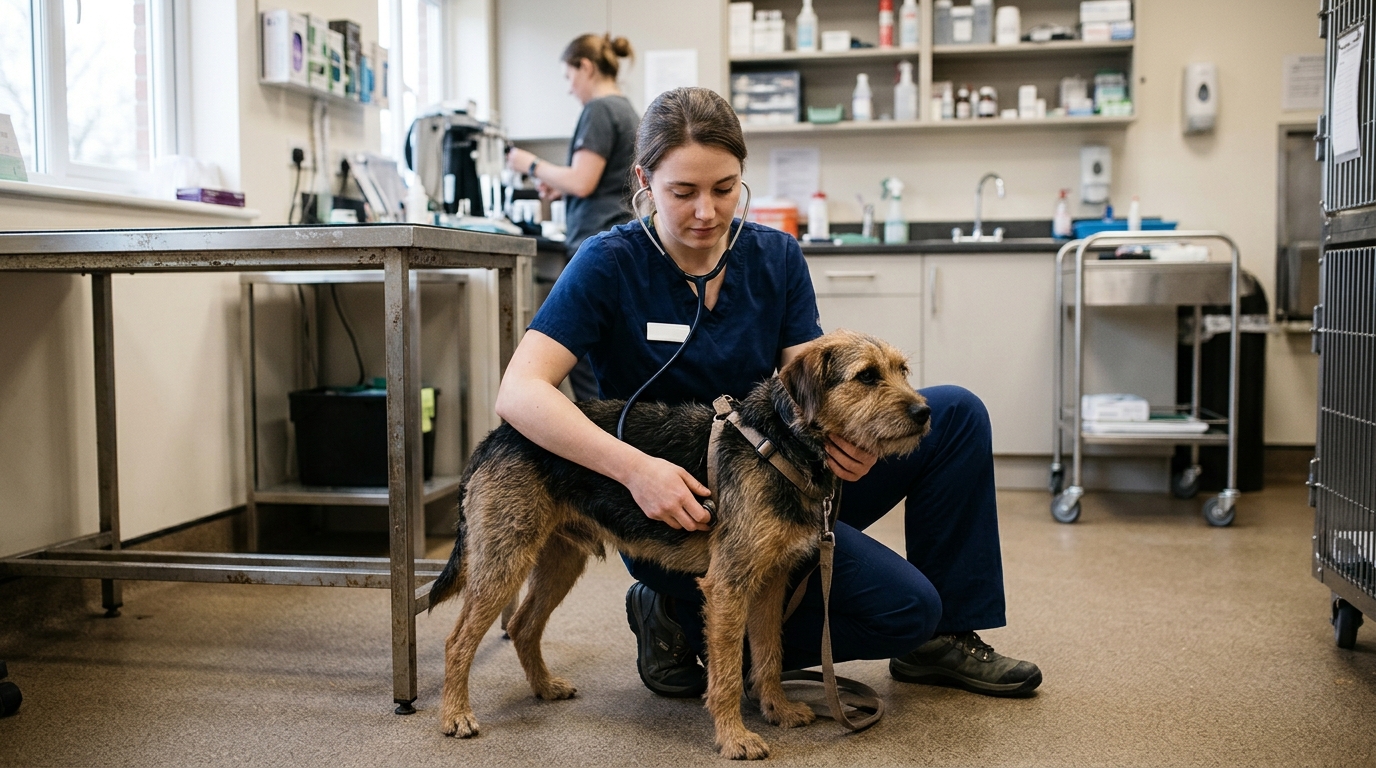
A veterinary technician's day is built around a treatment board and an appointment grid that rarely survive contact with walk-in emergencies. You spend most of it on your feet — restraining animals, placing IV catheters, running bloodwork, monitoring anesthesia and writing records.
This guide walks a general practice shift hour by hour, names the equipment and software you will touch, and sets out the credential route through an AVMA CVTEA-accredited program and the VTNE.
Job Snapshot
| Item | What to expect |
|---|---|
| Typical shift length | 8 to 12 hours; general practices commonly post 8- or 10-hour shifts and emergency hospitals 12-hour blocks — check the individual clinic's posting, since the employer sets this |
| Most common schedule type | Fixed weekdays with a rotating Saturday in general practice; rotating days, nights and holidays in emergency hospitals. The BLS Occupational Outlook Handbook entry for Veterinary Technologists and Technicians notes that work outside standard business hours is common in facilities open around the clock |
| Physical setting | Indoor clinical — exam rooms, central treatment area, surgery suite, dental station, radiology room and kennel ward; some mixed-practice roles work in barns and from a truck |
| Minimum entry credential | An associate degree from a program accredited by the AVMA Committee on Veterinary Technician Education and Activities (CVTEA), plus the Veterinary Technician National Examination (VTNE) administered by the AAVSB, in states that regulate the title. Rules and the title used — CVT, LVT or RVT — are set state by state |
| Pay structure | Hourly, with shift differentials for overnights and holidays in 24-hour hospitals; check the BLS Occupational Outlook Handbook and current postings in your state |
Before the Workday Begins
Most technicians dress at home in scrubs and non-slip closed-toe shoes, because the treatment floor is wet by 7:30 a.m. and there is no time to change. Rings come off, hair goes up, and you bring a watch with a second hand for respiration counts and drug intervals.
If you open, you arrive 15 to 30 minutes before the first appointment. Opening tasks are concrete:
- Walk the kennel ward, check every hospitalized patient's IV line and fluid pump, and record urine, feces, vomit and food intake on the cage card.
- Run quality control on the in-house chemistry and hematology analyzers so the 8:00 a.m. pre-anesthetic results are valid.
- Count the controlled drug safe against the log with a second person before the first dose is pulled.
- Leak-test the anesthesia machine and check the vaporizer level, oxygen tank pressure and soda lime canister.
- Read the surgery board and pull files, so you know whether the 9:00 a.m. spay is a 4-pound kitten or a 70-pound shepherd.
Hour by Hour Through the Shift
6:40 a.m. — Leave home in scrubs with a packed lunch; breaks are rarely long enough to leave the building.
7:00 a.m. — Unlock, treat hospitalized patients, and update the whiteboard treatment sheet with overnight notes.
7:45 a.m. — Admit surgical patients: confirm fasting, weigh, place an IV catheter, draw pre-anesthetic blood, get the consent and estimate signed.
8:30 a.m. — Run the pre-anesthetic panel on the in-house analyzer and enter results in the practice management software for the veterinarian to clear.
9:00 a.m. — Induce the first surgery. Intubate, connect the anesthesia machine and multiparameter monitor, and record heart rate, blood pressure, SpO2, end-tidal CO2 and temperature every five minutes.
10:15 a.m. — Recover and extubate once the swallow reflex returns, then start the second procedure — usually a dental with full-mouth digital radiographs and scaling.
10:50 a.m. — The weekly interruption: a hit-by-car dog or a blocked cat walks in. One technician leaves the dental to triage, place a catheter and pull emergency drugs. Remaining procedures slide back an hour and lunch disappears.
12:30 p.m. — Appointments resume. Room patients, take weight, temperature and history, restrain for the exam, draw blood, trim nails and give vaccines after the veterinarian examines.
1:45 p.m. — Run fecals and urinalyses, read a blood smear, spin samples, and package out-of-house samples for the reference lab courier.
2:15 p.m. — A dehydrated 16-year-old cat's jugular stick fails twice. You switch to a medial saphenous draw and a smaller needle, and explain the delay to the client.
3:00 p.m. — Discharges: demonstrate ear medication, dispense prescriptions, explain post-operative restrictions, and record the conversation.
4:30 p.m. — A scheduled euthanasia. Place the catheter, prepare the solution, sit with the family, then handle body care and cremation paperwork.
5:15 p.m. — Callbacks on yesterday's surgeries, lab results entered, controlled drug log reconciled, autoclave loaded with tomorrow's surgical packs.
6:00 p.m. — Hand off hospitalized patients to the overnight technician, mop the treatment area and clock out — later if the 5:45 p.m. walk-in became an admission.
Tools, Equipment, and Software Used Daily
- In-house analyzers such as IDEXX Catalyst/ProCyte or Abaxis VetScan for chemistry, CBC and electrolytes
- Anesthesia machine with isoflurane or sevoflurane vaporizer and endotracheal tubes
- Multiparameter monitor with ECG, pulse oximetry, capnography and Doppler or oscillometric blood pressure
- Digital radiography and dental radiography units, with lead gowns, thyroid shields and dosimetry badges
- Ultrasonic dental scaler, polisher, hand curettes and extraction elevators
- IV fluid pumps and syringe pumps for constant-rate infusions
- Microscope for blood smears, fecal flotations, ear cytology and urine sediment
- Centrifuge, refractometer, glucometer and blood gas analyzer
- Autoclave and surgical pack wrapping supplies
- Practice management software — Cornerstone, AVImark, ezyVet or Instinct
- Controlled substance logbook and DEA-compliant drug safe
- Muzzles, cat bags, E-collars and towels for restraint
- Crash cart with Ambu bag and a calculated emergency drug dose chart
The Toughest Part of the Job
The hardest recurring element is the emotional whiplash of back-to-back appointments with opposite tones. At 4:30 p.m. you place the catheter for a euthanasia, hold a dog's head while the owner says goodbye, then carry the body to the cooler and fill out the cremation form. At 4:50 p.m. you walk into a room where a family is photographing a new puppy. A 20-minute appointment grid builds in no decompression time.
The second strain is financial limitation. You prepare a treatment plan you know would help, and the owner declines it because they cannot pay. You then carry out the lesser option — or the euthanasia — knowing what was medically possible.
The physical side compounds it: two-person lifts of 80-pound dogs onto treatment tables, standing for 10 hours on sealed concrete, and cat bites during restraint. A deep cat bite to the hand is a same-day urgent care visit, not something you work through.
Signs This Job Fits Your Personality
- You can abandon a task for a 40-minute emergency and pick it up again without losing your place.
- You are comfortable being bitten, scratched or urinated on and finishing the shift anyway.
- You can hold a frightened 70-pound dog still with your body weight while someone else works.
- You can explain a medication schedule three times to the same client without changing your tone.
- You can keep a timed anesthesia record while watching a monitor and a patient at once.
- You accept that roughly two hours of the shift is records, logs and callbacks.
- You can leave a euthanasia room and immediately take a history next door.
- You are willing to work rotating Saturdays, and in a 24-hour hospital, nights and holidays.
How to Break Into This Career
- Check your state's rules (one week). Contact your state veterinary medical board or technician association to learn whether the state licenses, certifies or registers technicians, and which title it uses — CVT, LVT or RVT. A few states do not regulate the title.
- Enroll in an AVMA CVTEA-accredited program (two to four years). The AVMA publishes the accredited list, including distance programs that require supervised clinical hours at an approved practice. Associate degrees typically take two years full time.
- Work as a veterinary assistant or kennel attendant while studying (ongoing). General practices, emergency hospitals and shelters hire assistants without a credential, which builds restraint, venipuncture and record-keeping hours for your skills workbook.
- Complete the required externship or preceptorship (6 to 16 weeks). Your program places you; clinics frequently hire the externs they trained.
- Apply for and sit the VTNE. The AAVSB administers it in set testing windows each year; you apply through your state board or credentialing body, then schedule at a testing center. Check the AAVSB site for current windows and eligibility.
- Submit your state credentialing application (4 to 12 weeks to process). Expect transcripts, VTNE scores, a background check, a fee, and in some states a jurisprudence exam on state practice law.
- Apply through clinic websites, the AVMA Veterinary Career Center, NAVTA job listings, state VMA boards and corporate hospital career portals. Emergency hospitals often hire credentialed technicians with no prior ER experience and train on the job.
- Consider a Veterinary Technician Specialty later (three or more years in). NAVTA recognizes academies in anesthesia, emergency and critical care, dentistry and internal medicine, each requiring case logs and a specialty exam.
Frequently asked questions
Do veterinary technicians actually perform medical procedures, or just assist?
Credentialed technicians place IV catheters, induce and monitor anesthesia, take radiographs, perform dental cleanings, run diagnostics and administer medications. What they cannot do in any state is diagnose, prescribe, perform surgery or give a prognosis — those are reserved to the licensed veterinarian. The exact scope line sits in your state practice act, so read it before accepting a role.
How often do you get bitten or injured?
Scratches and minor bites are common enough that most practices keep a bite incident log and a post-exposure protocol. Cat bites to the hand carry a high infection risk and are usually treated same-day with antibiotics rather than monitored. Back injuries from lifting are the other frequent claim, which is why many hospitals require two-person lifts above a set weight.
Is a break guaranteed during a shift?
Meal and rest break rules come from state labor law, not the veterinary field, and they differ substantially between states. In practice, a hospitalized patient or walk-in often interrupts a scheduled break. Ask in an interview how the clinic handles missed breaks and whether they are paid.
How does an overnight emergency shift differ from general practice?
Overnight work drops the appointment grid entirely, so triage order drives the night — the most unstable patient is seen first regardless of arrival time. You handle more CPR, oxygen cages and constant-rate infusions, and far fewer vaccines and nail trims. You typically work a set number of nights per rotation rather than a fixed weekday pattern.
Can you move into other work with this credential?
Technicians move into practice management, pharmaceutical and diagnostic sales, laboratory animal medicine, zoo and shelter medicine, and teaching in CVTEA-accredited programs. Laboratory animal roles often ask for AALAS certification at the ALAT, LAT or LATG level alongside your state credential. Some use the degree toward veterinary school, which requires a separate prerequisite track and the DVM application cycle.

Written by
Priya Nandakumar
Priya covers the texture of offices, remote teams, and the spaces in between — what makes a workplace bearable or unbearable long after the paycheck stops mattering. She likes stories where nobody is the villain.