What Does a Phlebotomist Actually Do All Day?
A clock-by-clock look at tray setup, inpatient rounds, outpatient draws, specimen labeling and sharps disposal in a single phlebotomy shift.
By Tobias Lindqvist · Oct 26, 2026 · 5 min read
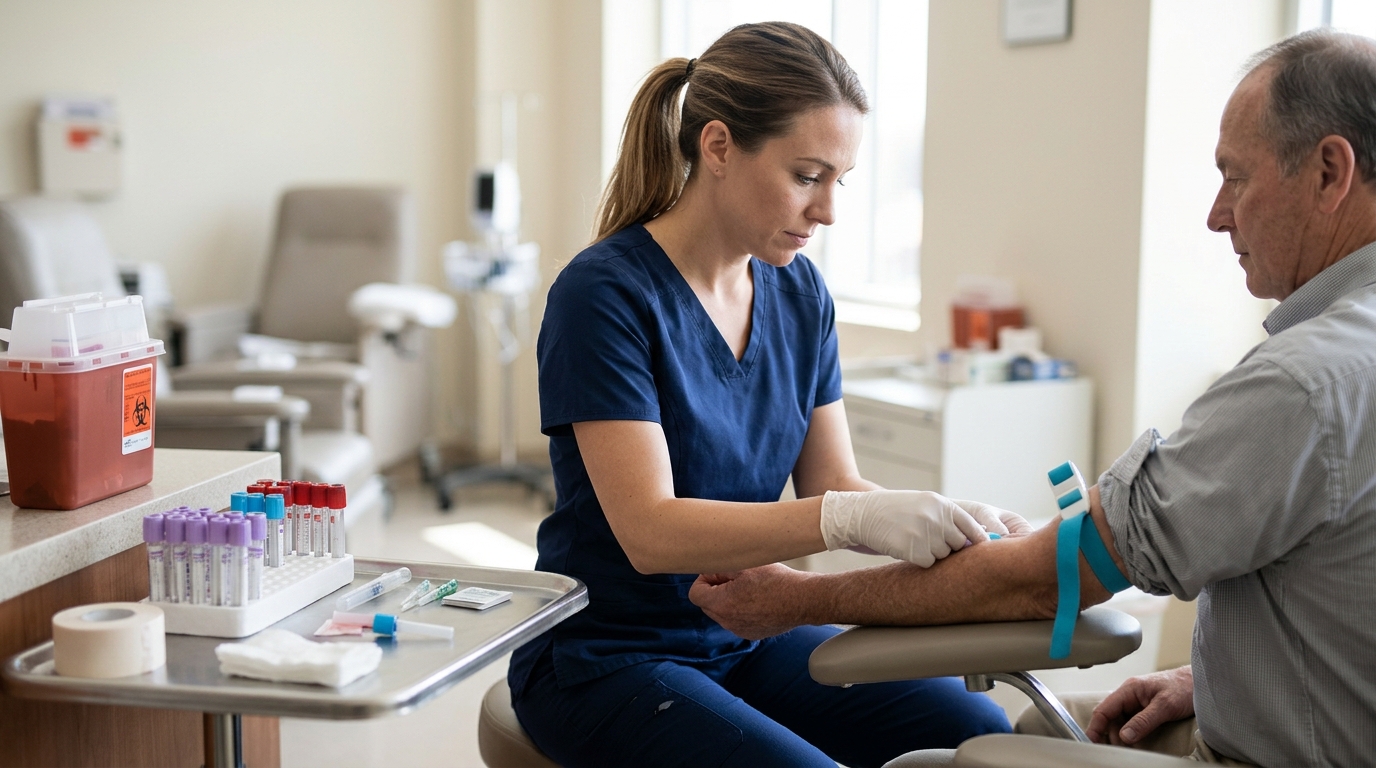
A phlebotomist spends the shift drawing blood from patients or donors, confirming each person's identity, labeling tubes and containers, entering sample information into a database, and keeping the draw station and instruments clean (U.S. Bureau of Labor Statistics, 2025). Most of that happens on your feet, in short face-to-face encounters that repeat dozens of times between clock-in and clock-out.
The structure of the day depends on the setting: hospital floors run on scheduled collection rounds, while labs and clinics run on whoever walks through the door.
At a Glance
| Item | What the data says |
|---|---|
| Typical hours | Most phlebotomists work full time; those in hospitals and labs may need to work nights, weekends, and holidays (U.S. Bureau of Labor Statistics, 2025) |
| Work setting | Hospitals 36%, medical and diagnostic laboratories 33%, other ambulatory healthcare services 16%, offices of physicians 9%, outpatient care centers 2% (U.S. Bureau of Labor Statistics, 2025) |
| Physical demand | Standing for long periods is common; 36% of respondents said they spend time standing continually or almost continually (O*NET OnLine, U.S. Department of Labor) |
| Contact with people | 88% of respondents reported constant contact with others (O*NET OnLine, U.S. Department of Labor) |
| Exposure and protective gear | 80% of respondents said they are exposed to disease or infections every day, and 88% said gloves or other common protective equipment are required every day (O*NET OnLine, U.S. Department of Labor) |
| Entry requirement | Typically a certificate from a postsecondary phlebotomy program, usually under one year at a community college, vocational school, or technical school; some qualify with a high school diploma and on-the-job training (U.S. Bureau of Labor Statistics, 2025) |
What a Typical Day Looks Like
On a hospital day shift you clock in at 6:40 a.m., change into scrubs and stock your tray: needles, holders, test tubes, blood vials, tourniquets, alcohol wipes, gauze and gloves. At 7:00 a.m. you start collection rounds with the overnight requisition list, and at each bedside you confirm the patient's identity by verifying their personal information against the wristband, explain what you are about to do to help the patient relax, draw the tubes in order, then match the laboratory requisition form to the specimen tubes and label them at the bedside before you leave the room. Contaminated sharps go into the sharps container in accordance with your facility's policy. By 9:30 a.m. you are at the outpatient draw station, working through scheduled appointments and walk-ins, labeling sterile containers for urine samples, and entering sample information into the laboratory database. You break at 12:15 p.m. From 1:00 p.m. you restock the tray, wipe down the draw chair and armrest, and hand off or transport specimens to the lab — some employers require a driver's license for staff who move samples (U.S. Bureau of Labor Statistics, 2025). At 2:45 p.m. you clear the pending list, log difficult draws for the next shift, and clock out at 3:30 p.m. Evening, night, and weekend versions of this shift exist in hospitals and labs.
Daily Tasks You'll Actually Do
- Stock a draw tray with needles, test tubes, blood vials, gauze and gloves before your first patient.
- Confirm each patient's or donor's identity by verifying their personal information against the wristband or ID.
- Explain the draw in a sentence or two to help a nervous patient or donor relax.
- Draw blood using a venipuncture or fingerstick, then apply gauze and check the site.
- Match laboratory requisition forms to specimen tubes and label tubes before leaving the room.
- Label sterile containers for other samples, such as urine, and enter sample information into the laboratory database.
- Dispose of contaminated sharps in the sharps container in accordance with applicable laws, standards, and facility policy.
- Wipe down the draw chair, armrest and work surface between patients and at the end of the shift.
Quick Fit Check
- Can you stand and walk for most of a shift rather than sit at a desk? (36% of O*NET respondents stand continually or almost continually.)
- Are you willing to speak to a new person every few minutes, all shift? (88% of O*NET respondents report constant contact with others.)
- Are you comfortable working near blood, urine samples and used needles every day? (80% of O*NET respondents are exposed to disease or infections daily.)
- Will you wear gloves and other protective equipment for the whole shift without skipping it? (88% of O*NET respondents say it is required every day.)
- Can you work nights, weekends or holidays if a hospital or lab schedule requires it (U.S. Bureau of Labor Statistics, 2025)?
- Can you re-check a name and date of birth on a tube at 7:00 a.m. with the same care as at 3:00 p.m.?
Frequently asked questions
What credentials do I need before my first shift?
Most people complete a phlebotomy certificate at a community college, vocational school, or technical school in under a year, covering anatomy, physiology, medical terminology, and laboratory work (U.S. Bureau of Labor Statistics, 2025). Employers may also want Basic Life Support certification and professional certification, which can involve an exam plus a practical component such as drawing blood; states may separately require accredited training, a license, or certification, so contact your state licensing agency for the rules where you work.
How is phlebotomist pay usually structured?
Most roles are paid hourly on a full-time schedule, with extra differentials common for night, weekend, and holiday hours in hospitals and labs. Check the U.S. Bureau of Labor Statistics Occupational Outlook Handbook for current national and state wage data, and compare it against live job postings in your area.
Sources
- U.S. Bureau of Labor Statistics — Phlebotomists : Occupational Outlook Handbook (2025)
- O*NET OnLine (U.S. Department of Labor) — 31-9097.00 - Phlebotomists

Written by
Tobias Lindqvist
Tobias writes on trades, apprenticeships, and the kinds of careers that don't start with a resume. He's interested in skill as a form of dignity, and in how little the discourse around work usually accounts for hands.