Plumber vs. HVAC Technician Salary: Full Pay Comparison
How the two trades line up on median, entry and top-end pay, which published series to compare, and what pushes one ahead in your state.
By Tobias Lindqvist · Oct 26, 2026 · 8 min read
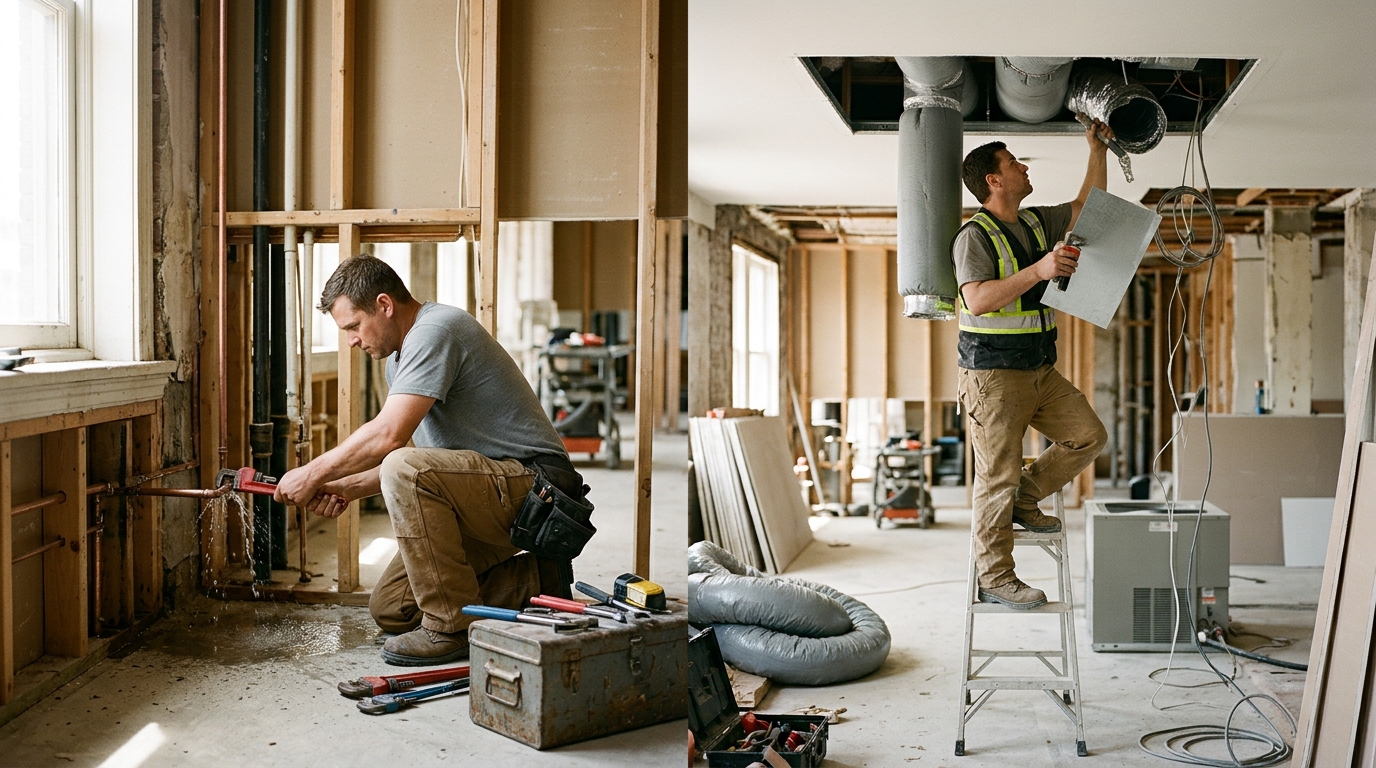
Plumbers and HVAC technicians sit close together in US national pay data, and in most states the difference between the two trades is smaller than the difference between a union shop and a non-union one, or between new-construction work and 24/7 service work. The honest comparison is not one national number but four: the annual median, the 10th percentile, the 90th percentile, and how fast you move up the apprenticeship steps.
This guide shows you exactly which figures to pull — the BLS Occupational Employment and Wage Statistics (OEWS) series for plumbers, pipefitters and steamfitters (SOC 47-2152) and for heating, air conditioning and refrigeration mechanics and installers (SOC 49-9021) — and explains the structural reasons the gap opens where it opens.
Side-by-Side Pay Comparison
Pay figures go stale within a year, so rather than freezing numbers here, this table gives you the exact data point to look up for each trade. Pull both from the same release so the units and reference date match.
| Dimension | Plumber (SOC 47-2152) | HVAC technician (SOC 49-9021) |
|---|---|---|
| Median pay | BLS OEWS annual median wage, 50th percentile, latest May reference year | BLS OEWS annual median wage, 50th percentile, same May reference year |
| Entry-level pay | BLS OEWS 10th percentile annual wage | BLS OEWS 10th percentile annual wage |
| Top-end pay | BLS OEWS 90th percentile annual wage | BLS OEWS 90th percentile annual wage |
| Hourly equivalent | BLS OEWS median hourly wage (use hourly against hourly only) | BLS OEWS median hourly wage (use hourly against hourly only) |
| Raise timeline | Registered apprenticeship: 4–5 years, roughly 8,000 on-the-job hours, step increases typically every 6 months or 1,000 hours, usually starting near 40–50% of the journeyman rate | Certificate or associate route: 6–24 months of training plus EPA Section 608 certification, then employer-set reviews, commonly annual; registered HVAC apprenticeships run 3–5 years on the same step structure |
| What the figure excludes | OEWS excludes overtime premium pay and non-production bonuses | OEWS excludes overtime premium pay and non-production bonuses; residential replacement commissions are reported inconsistently |
Two rules make the comparison arithmetically valid. First, compare annual to annual or hourly to hourly, never one against the other — OEWS annual figures assume year-round full-time work, which seasonal HVAC install crews in northern states often do not get. Second, compare the same percentile: a plumbing 90th percentile against an HVAC median tells you nothing.
If you want a second reading, state workforce agencies publish their own occupational wage tables built from the same OEWS survey, and union locals publish current journeyman wage-and-fringe schedules in their collective bargaining agreements. Both carry a date — check it before you use the number.
Pay by Experience and Location
Each row pairs the two trades at the same tier so the figures sit next to each other. All rows are annual unless marked hourly. Fill the cells from one BLS OEWS release and note the May reference year at the top of your sheet.
| Tier or region | Plumber figure to pull (SOC 47-2152) | HVAC figure to pull (SOC 49-9021) |
|---|---|---|
| Apprentice / first year | OEWS 10th percentile annual wage, national | OEWS 10th percentile annual wage, national |
| Early career | OEWS 25th percentile annual wage, national | OEWS 25th percentile annual wage, national |
| Journeyman / mid-career | OEWS 50th percentile (median) annual wage, national | OEWS 50th percentile (median) annual wage, national |
| Experienced / lead tech | OEWS 75th percentile annual wage, national | OEWS 75th percentile annual wage, national |
| Top 10% (master, service manager, owner-operator) | OEWS 90th percentile annual wage, national | OEWS 90th percentile annual wage, national |
| Your state | OEWS state-level annual median wage | OEWS state-level annual median wage |
| Your metro area | OEWS metropolitan area annual median wage | OEWS metropolitan area annual median wage |
| Union scale | Current journeyman hourly wage plus fringe package in your local's agreement, with its effective date | Current journeyman hourly wage plus fringe package in the relevant local's agreement, with its effective date |
Two cautions when you read state rows. OEWS state medians are not cost-of-living adjusted, so a high state median in a high-cost metro can leave you with less than a mid-ranked state. And OEWS reports wages, not hours — if HVAC install work in your region shuts down for two months of the year, the annual median overstates what a first-year installer actually banks.
For the union rows, read the wage-and-fringe split carefully. A collective bargaining agreement states a journeyman hourly base rate and then a separate per-hour employer contribution to pension, health and training. The base rate is what drives your overtime multiplier and your taxable take-home; the fringe is real money but you do not see it in your paycheck.
Why the Pay Gap Exists
Where plumbing edges ahead, it is rarely because the work is harder. It is because of four structural things you can check for yourself.
Licensing depth. Every US state regulates plumbing at the journeyman or master level, or delegates it to counties and cities that do. The common path to a master plumber license is a 4–5 year registered apprenticeship of roughly 8,000 on-the-job hours plus at least 144 hours of related classroom instruction per year, followed by a period of journeyman experience and a state exam. HVAC licensing is less uniform: some states license HVAC contractors statewide, some only at city or county level, and some not at all. The one federal requirement that applies everywhere is EPA Section 608 certification to purchase or handle refrigerants, which is a single exam, not a multi-year program. A longer, more tightly gated credential restricts supply, and restricted supply shows up in the 75th and 90th percentile figures more than in the median.
Union presence. Plumbers and pipefitters have a long-established building-trades structure, and union agreements set a published hourly journeyman rate plus a defined fringe contribution for the life of the contract, usually with scheduled increases written in. Non-union HVAC service work is more often set employer by employer, with pay reviews on no fixed calendar. Check your own area: a local's published wage schedule carries an effective date and a rate, and an employer's offer does not.
What each trade sells. Residential HVAC is an equipment-replacement business, so many HVAC service companies pay a commission or spiff on system sales on top of an hourly base. That can lift total compensation well above the OEWS figure — and OEWS reports gross straight-time pay excluding overtime, so it captures incentive pay unevenly. Ask any HVAC employer for the written commission plan and whether it pays on gross price or gross margin. Plumbing service leans more on emergency callouts, which pay through on-call stipends and the FLSA overtime minimum of 1.5x the regular rate past 40 hours in a workweek.
Seasonality. HVAC demand concentrates in the hottest and coldest weeks of the year, which produces heavy overtime in those windows and slack in the shoulder seasons. Plumbing demand is steadier because leaks, blockages and fixture failures do not follow the weather. If you are comparing two offers, compare guaranteed annual hours, not just the hourly rate — 2,080 hours at a lower rate can beat 1,700 hours at a higher one.
Frequently asked questions
Which trade pays more at the very top of the range?
Plumbing typically pulls ahead at the 90th percentile rather than the median, and the reason is the licence: most states route you to a master plumber credential through a 4–5 year, roughly 8,000-hour apprenticeship plus journeyman time and a state exam, which supports contracting work on your own licence. Compare the BLS OEWS 90th percentile annual wage for SOC 47-2152 against the same percentile for SOC 49-9021 in the latest May release to see the current size of that gap in your state.
Does HVAC pay more in the summer?
HVAC technicians, not plumbers, see the sharpest seasonal swing, because cooling failures cluster in a few weeks. Those hours are paid at the FLSA minimum of 1.5x your regular rate past 40 in a workweek, and that premium is excluded from every BLS OEWS figure — so an HVAC tech's actual annual earnings in a hot-summer market can sit above the published OEWS median for SOC 49-9021 while the base rate does not.
Can I start earning faster as an HVAC technician?
Usually yes. HVAC entry commonly runs 6–24 months through a certificate or associate program plus the federal EPA Section 608 exam, against the 4–5 year registered apprenticeship that most state plumbing licences require. The trade-off shows in the BLS OEWS 10th percentile annual wage for SOC 49-9021 — compare it with the plumbing 10th percentile, since plumbing apprentices typically start near 40–50% of the journeyman rate but move up on scheduled steps every 6 months or 1,000 hours.
Where do I check current numbers for each trade?
Use the BLS OEWS tables and look up both occupation codes in the same release: 47-2152 for plumbers, pipefitters and steamfitters, and 49-9021 for HVACR mechanics and installers. Each release carries a May reference year, gives national, state and metro figures, and reports both hourly and annual wages at the 10th, 25th, 50th, 75th and 90th percentiles. For union plumbing work specifically, also read the current journeyman wage-and-fringe schedule in your local's agreement and check its effective date.

Written by
Tobias Lindqvist
Tobias writes on trades, apprenticeships, and the kinds of careers that don't start with a resume. He's interested in skill as a form of dignity, and in how little the discourse around work usually accounts for hands.