HVAC Technician Salary: Average Pay by State, Experience, and Specialty
Where the official wage tables live, how hourly base stacks up against overtime, on-call and spiffs, and which skills move a technician into the top percentiles.
By Harlan Voss · Oct 26, 2026 · 11 min read
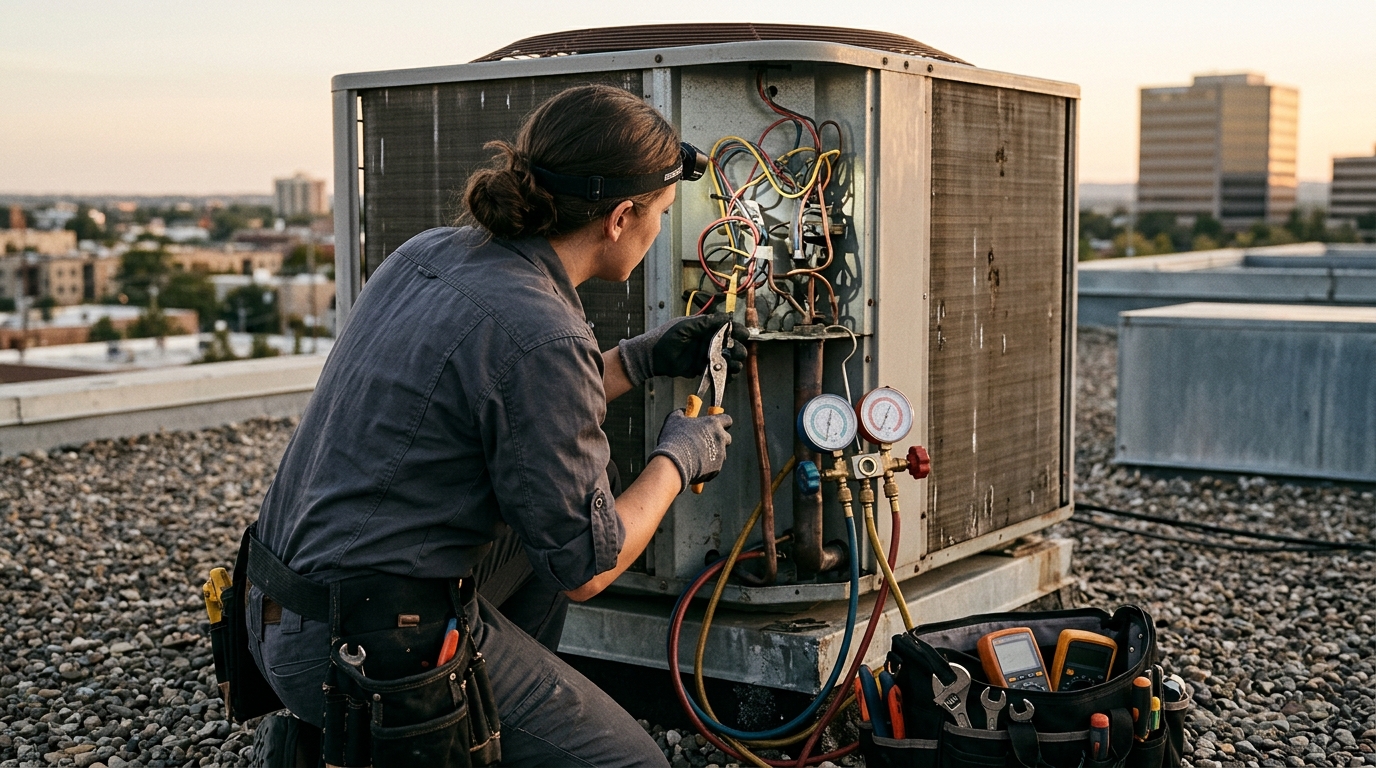
Most HVAC technicians in the US are paid an hourly base rate, with overtime, on-call pay, shift differentials and sometimes commission on top — so the number on your pay stub and the number in a job ad often describe different things. The checkable national, state and metro wage figures for this trade come from the US Bureau of Labor Statistics Occupational Employment and Wage Statistics (OEWS) program, under the occupation code 49-9021, Heating, Air Conditioning, and Refrigeration Mechanics and Installers, which is republished each year with a May reference date.
What moves your own number within that spread: your license and certification status, whether you do residential installs or commercial and industrial service, union or non-union shop, employer type, and the metro you work in.
What HVAC Technicians Earn
The primary US source for this trade is the BLS Occupational Employment and Wage Statistics (OEWS) survey, occupation 49-9021. Open the current release — the data year is printed at the top of every OEWS table as a May reference month — and you will get, for this one occupation: a mean hourly wage, a mean annual wage, and hourly and annual figures at the 10th, 25th, 50th (median), 75th and 90th percentiles. Read the percentiles, not just the mean. The median tells you what the middle technician makes; the gap between the 10th and the 90th tells you how much room there is above you.
Two mechanical points to get right before you compare anything. First, state whether you are talking hourly or annual and stay in those units. OEWS converts between them using 2,080 hours (40 hours a week, 52 weeks), which assumes no overtime and no unpaid weeks — if your shop runs heavy summer overtime, your actual annual earnings will sit above the annual figure implied by your base rate. Second, OEWS wage data is base wage plus certain regular payments; it is not a total-compensation number. Bonuses, spiffs on equipment sales, on-call stipends, truck and tool allowances, health coverage and pension or 401(k) contributions sit outside it.
For a cross-check, state workforce agencies publish their own occupational wage pages built on the same OEWS data, usually with regional breakouts BLS does not print. Private salary surveys and job-board aggregators also publish HVAC figures; if you use one, note its sample source and year, because self-reported data and base-plus-overtime data are not interchangeable.
If you work outside the US, none of this applies directly — look for your national statistics agency's equivalent occupational earnings survey, and in Canada the provincial wage reports published through the Job Bank.
Pay by Experience Level
HVAC pay rises in steps rather than smoothly, and the steps are usually tied to what you are allowed to do unsupervised. Use this table alongside the OEWS percentile row for your state: apprentices generally sit in the lower percentiles, journey-level service techs around the middle, and specialists and leads in the upper quarter.
| Tier | Typical years | How pay is usually set | Where to check your number |
|---|---|---|---|
| Helper / pre-apprentice | 0–1 | Flat hourly rate, no refrigerant work until certified | State workforce agency entry-wage page; OEWS 10th percentile, hourly |
| Registered apprentice | 1–4 | A published percentage of the journeyman scale, stepping up at set hour milestones | Your apprenticeship standards document or union local's wage sheet |
| Journey-level service tech | 4–8 | Hourly base plus overtime at a federal multiplier of 1.5 over 40 hours for nonexempt workers, plus on-call | OEWS median (50th percentile) for your state, hourly and annual |
| Senior / lead tech | 8–15 | Higher hourly base, often a truck and tool allowance, sometimes commission on maintenance agreements | OEWS 75th percentile for your metro |
| Specialist or service manager | 15+ | Either a premium hourly rate (controls, industrial refrigeration) or a salary with a bonus tied to department margin | OEWS 90th percentile; for managers, the separate OEWS first-line supervisor code 49-1011 |
When you compare tiers, keep the units matched. A journeyman hourly rate multiplied by 2,080 is comparable to a manager's annual salary only if you strip the overtime out of the journeyman's year first — many senior field techs out-earn a salaried supervisor in a hot summer and fall behind in a slow spring.
Pay by State or Metro Area
OEWS publishes this occupation by state, by metropolitan statistical area and by nonmetropolitan area, so you can pull a median hourly figure for the exact market you are in rather than a national average that fits nobody. Rows below are ordered from the markets that typically post the highest OEWS wage figures for 49-9021 down to lower-cost markets — but the ranking shifts between releases, so confirm the order in the current year's table before you rely on it.
| State or metro | Why the local number lands where it does | What to pull |
|---|---|---|
| New York–Newark–Jersey City, NY-NJ | High union density in commercial mechanical work, licensing at city level | OEWS metro table, median and 75th percentile hourly |
| San Francisco–Oakland, CA | Expensive construction market, heavy commercial and lab work | OEWS metro table plus California state table |
| Seattle–Tacoma–Bellevue, WA | Commercial service and data-centre demand, organised shops | OEWS metro table, 90th percentile hourly |
| Boston–Cambridge–Newton, MA | Hospital, university and lab mechanical systems | OEWS metro table, median hourly |
| Chicago–Naperville–Elgin, IL | Large industrial refrigeration and controls base | OEWS metro table, median and 75th percentile |
| Houston–The Woodlands–Sugar Land, TX | Very large residential and petrochemical-adjacent market, long cooling season | OEWS metro table; note overtime is a bigger share of annual pay here |
| Phoenix–Mesa–Chandler, AZ | Heavy residential replacement volume, commission common | OEWS metro table plus employer's written spiff schedule |
Alaska and Hawaii usually look high in the state table and should be read against local costs. Pair any state figure with the Bureau of Economic Analysis Regional Price Parities for the same year — a higher median hourly wage in a coastal metro does not automatically mean more money left over at the end of the month.
Factors That Affect Pay
- EPA Section 608 certification. Federal rules require certification to purchase or handle most refrigerants. Without it you are a helper rate; with Universal (covering all three equipment types) you are billable on service calls. This is the single clearest step-change in a technician's hourly rate.
- State or local licensing. Requirements differ by state — some license at state level, some only at city or county level, and a few leave contracting licensure to the firm rather than the individual. Holding the license that lets a shop pull permits raises your rate because it raises what the shop can bill.
- Union status. Union shops pay a published scale with defined step increases plus pension and health contributions that do not appear in an hourly wage comparison. Non-union shops often pay more flexibly, with larger commission and bonus components. Compare total package, not just the hourly line.
- Employer type. Residential replacement contractors, commercial mechanical contractors, industrial refrigeration firms, facilities departments at hospitals, universities and school districts, and equipment manufacturers all pay differently for the same licence. Facilities roles typically trade a lower hourly base for steadier hours and better leave.
- Specialty. Building automation and controls, industrial and ammonia refrigeration, VRF systems, cleanrooms and critical-facility work are the premium lanes, because the pool of qualified techs is small and the downtime cost to the customer is high.
- Shift differentials and on-call. Night, weekend and holiday shifts usually carry a differential expressed as a percentage uplift or a flat hourly add-on, and being in the on-call rotation usually carries a weekly stipend plus a minimum callout payment. Both are set by employer policy — ask to see the written schedule.
- Overtime and season. Federal rules generally require 1.5 times the regular rate above 40 hours a week for nonexempt employees, and cooling-season overtime can be the largest single difference between two techs on identical base rates. Ask how many overtime hours the shop actually ran last summer.
- Commission and spiffs. In residential service, part of the pay is often tied to maintenance agreements sold, accessories attached or equipment replacements closed. This raises earning potential and raises variability — know the base rate underneath it.
How to Increase Your Pay in This Role
- Get EPA Section 608 Universal rather than a single type. Type I, II and III each limit which equipment you can legally service; Universal removes the limit and removes the reason a dispatcher skips you for the better calls.
- Add controls and building automation. Learn to commission, program and troubleshoot a BAS front end, not just the mechanical equipment. Techs who can read a controls sequence and stay on a network are routinely moved onto higher-billed commercial accounts.
- Move from residential install to commercial or critical-facility service. The common pattern is install crew to residential service to commercial service, with each move adding complexity, diagnostics and after-hours work. Data centres, hospitals and food-processing plants pay for 24/7 availability — decide whether you want that trade before you take it.
- Negotiate with the OEWS table open. Bring the current-year 75th percentile hourly figure for your own metro, printed with its data year, plus your own numbers: callback rate, first-time-fix rate, agreements sold, hours of overtime carried. Ask for the rate, then ask separately for the truck allowance, tool allowance, boot and phone reimbursement and the on-call stipend in writing.
- Use the journey-level switch deliberately. Rates in this trade often reset when you change employers rather than when you stay. If you are at the top of a small shop's internal band, the larger raise is usually at a commercial mechanical contractor or a facilities department — but check their overtime volume, because a higher base with no overtime can net less than your current year.
- Stack manufacturer and industry certifications your market actually asks for. Call three local contractors and ask which credentials they pay a premium for before you spend a weekend on one. Manufacturer factory training on the equipment lines your area installs tends to convert faster than a general certificate.
Frequently asked questions
Where do I find the official average HVAC technician wage?
Use the BLS Occupational Employment and Wage Statistics (OEWS) tables for occupation 49-9021, Heating, Air Conditioning, and Refrigeration Mechanics and Installers. Each release carries a May reference date, and gives mean plus 10th, 25th, 50th, 75th and 90th percentile wages in both hourly and annual form, nationally and for every state and metro area. Your state workforce agency republishes the same data with extra regional detail.
Are HVAC technicians paid hourly or on a salary?
Most field technicians are hourly and nonexempt, which under federal rules generally means overtime at 1.5 times the regular rate above 40 hours in a week. Service managers, estimators and some senior specialists are more often salaried. To compare the two, multiply the hourly rate by 2,080 — that is the figure OEWS uses to convert hourly to annual, and it assumes zero overtime.
Does EPA 608 certification increase what I earn?
It changes what work you can legally do, which is what changes your rate. Section 608 has 4 certification types — I for small appliances, II for high-pressure, III for low-pressure and Universal for all three. Most service employers want Universal, and a technician who cannot handle refrigerant is usually paid as a helper.
Which HVAC specialties tend to pay the most?
Building automation and controls, industrial and ammonia refrigeration, and critical-facility work such as data centres and hospitals sit at the top of the range. You can see this indirectly in OEWS: pull the same occupation code 49-9021 by industry (NAICS) in the current-year release and compare the median hourly wage across contractor, manufacturing and institutional employers.
How much does state or metro location change the number?
Enough that a national median is close to useless for a single job decision. OEWS covers all 50 states plus several hundred metropolitan and nonmetropolitan areas, and the spread between the highest and lowest areas within one release is wide. Check the figure against Bureau of Economic Analysis Regional Price Parities for the same data year before concluding that a move pays.
What should I bring to a pay review?
Three things: the current-year OEWS 75th percentile hourly figure for your metro with the data year stated, your own first-time-fix and callback numbers for the last 12 months, and a written list of the non-wage items you want confirmed — on-call stipend, shift differential percentage, truck and tool allowance, and who pays for recertification.

Written by
Harlan Voss
Harlan covers the business of job-seeking itself — the coaches, platforms, and advice industries that have grown up around finding work. He writes with a skeptic's patience and a soft spot for anyone still trying.