How to Become an HVAC Technician When You're Coming From an Office Job
What transfers from desk work, what the EPA refrigerant exam involves, and how long training runs before you are trusted with a customer's furnace.
By Tobias Lindqvist · Oct 26, 2026 · 11 min read
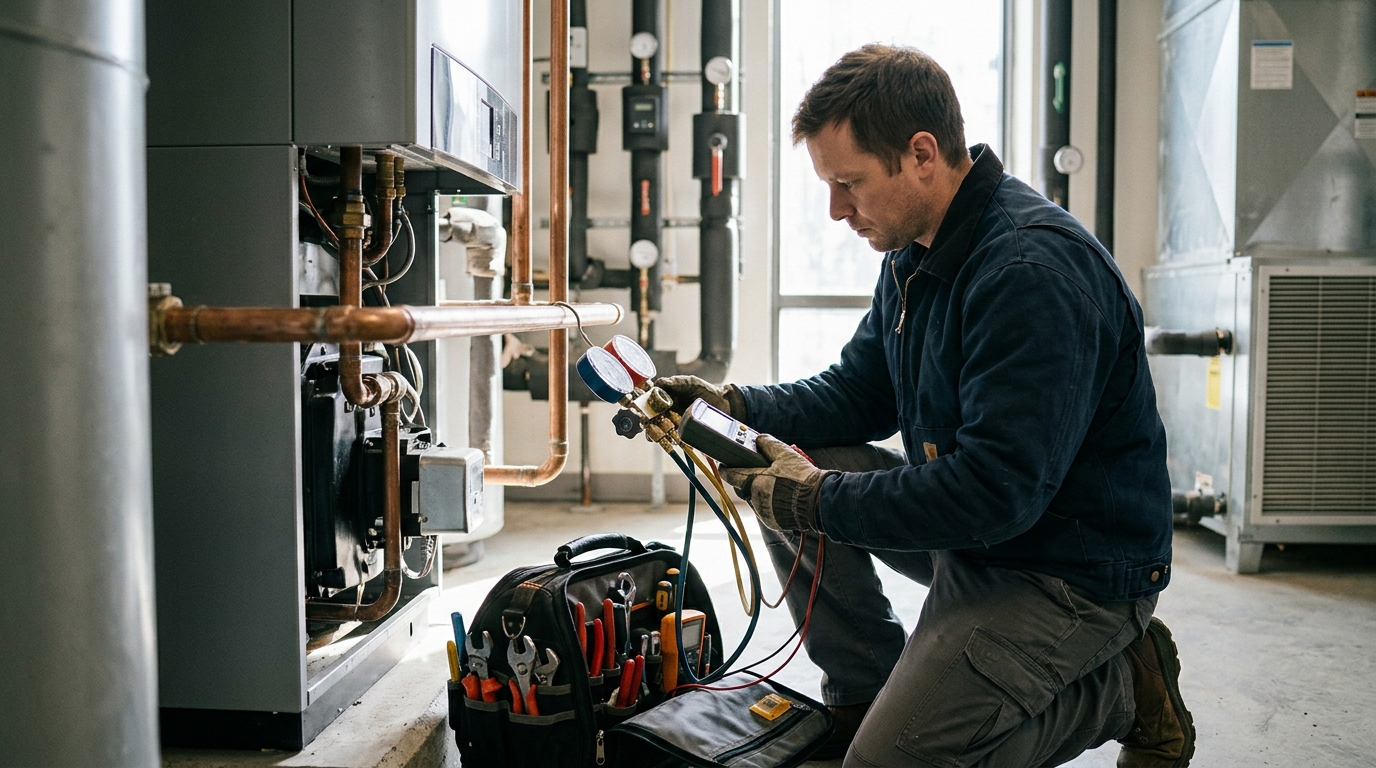
You can move from an office job into HVAC without any trade background — the U.S. Bureau of Labor Statistics lists no required work experience in a related occupation for entry. The usual route is a postsecondary certificate or associate's program lasting 6 months to 2 years, or a paid registered apprenticeship running three to five years, plus EPA refrigerant certification that costs roughly $25 to $85 to sit.
The parts of office work that carry over are narrower and more useful than most career-changers expect: ticket triage, invoice coding, contract reading and calendar discipline all map onto named HVAC tasks. The parts that do not carry over are the schedule, the weather and the crawlspaces.
Your Skills, Translated
Office work gives you more than you think, but only if you name the specific task rather than the job title. Here is how the most common desk-job functions line up with work HVAC employers actually pay for.
| Old-career skill | New-career equivalent | How to frame it on a resume |
|---|---|---|
| IT help desk ticket triage: narrowing a fault from a vague user report | Troubleshooting and Operations Monitoring, two of the skills CareerOneStop lists for this occupation (U.S. Department of Labor, using O*NET data) | "Diagnosed 20-30 reported faults per week by isolating symptoms from user descriptions; escalated only after ruling out common causes" |
| Accounts payable invoice coding and expense reconciliation | Maintaining complete records of work performed, including time taken and specific parts and equipment used — the Bureau of Labor Statistics names this as a core detail-orientation requirement | "Coded and reconciled 300+ line items monthly with parts numbers and labour time; zero unmatched entries at quarter close" |
| Project coordinator scheduling in Outlook or a shared calendar, chasing slipped dates | Hitting customer appointment windows; the Bureau of Labor Statistics says technicians must be friendly, polite and punctual because they work in customers' homes and business offices | "Managed a 40-appointment weekly calendar across six stakeholders; rescheduled same-day without missed commitments" |
| Financial or operations analyst building Excel models with sizing assumptions | Calculating correct load requirements so equipment properly heats or cools a given space — a named math skill for the role | "Built sizing and forecast models in Excel using square-footage and capacity inputs; checked results against actual outcomes monthly" |
| Insurance claims adjusting or paralegal work: reading a policy and applying clauses to facts | Reading Comprehension, an essential skill for the occupation per O*NET, applied to blueprints, wiring diagrams and manufacturer installation manuals | "Interpreted technical and contractual documents daily; applied written specifications to individual cases without supervisor review" |
| Inside sales or account management: explaining a price difference to a sceptical buyer | Explaining a repair-versus-replace choice to a homeowner standing next to a 19-year-old furnace | "Presented tiered options to 15+ customers weekly and documented the agreed scope in writing before work began" |
| Call centre de-escalation on a service outage | Working a no-heat call in January with a customer who has already waited two days | "Handled 25+ escalated contacts weekly; kept customers informed of arrival times and next steps during outages" |
| Compliance or QA auditing against a written standard | Safety practices, OSHA 10 or 30 and First Aid/CPR, which Wisconsin's registered HVAC Installer-Technician apprenticeship requires alongside its hours | "Audited work against documented safety and quality standards; recorded findings and corrective actions" |
| Technical writing or process documentation | Writing service tickets another technician can act on at the next visit | "Wrote step-by-step procedures used by 10+ colleagues; rewrote vendor documentation for field use" |
Realistic Transition Timeline
This assumes you keep your office job for the first stretch and train in evenings or weekends. Compress it if you enrol full time; stretch it if you take the apprenticeship route, which pays you but runs longer.
Weeks 1-4 — decide whether your state is involved. Some states and localities require HVAC technicians to be licensed and some do not (U.S. Bureau of Labor Statistics, undated); CareerOneStop publishes state licensing board requirements. Milestone: a one-page note naming your state's requirement, three local training providers with their total cost, and whether registered apprenticeships are open in your area. Cost: nothing but about six hours.
Months 1-3 — pass EPA Section 608. There are no prerequisites for the exam; the only official requirement is passing an EPA-approved proctored test. Each section needs at least 18 of 25 questions right, a score of 72 percent. Milestone: a certification card in your wallet that never expires, for a fee of roughly $25 to $85 through organisations such as ESCO Institute, Mainstream Engineering or HVAC Excellence. Budget 15-25 hours of study.
Months 2-12 — enrol and finish the classroom portion. Programs at technical schools, trade schools and community colleges run 6 months to 2 years and lead to a certificate or an associate's degree. Milestone: completion of the electrical and refrigeration-cycle modules, which is usually the point you become employable as a helper.
Months 6-15 — first paid HVAC work. Newly hired technicians work alongside experienced ones, starting with insulating refrigerant lines and cleaning furnaces. Milestone: 90 days in the field without a callback caused by your own work. Expect your first summer to include overtime during cooling-season peaks.
Months 12-30 — move up the task ladder. After the basics you progress to cutting and soldering pipes and checking electrical circuits. Milestone: running a straightforward maintenance call solo, with your own van stock list.
Years 2-5 — if you chose the apprenticeship route. A Department of Labor registered apprenticeship takes three to five years and typically includes 144 hours of classwork and 2,000 hours of on-the-job training per year. Wisconsin's registered HVAC Installer-Technician apprenticeship takes about five years, with 7,824 on-the-job hours and 576 paid related instruction hours, plus First Aid/CPR and OSHA 10 or 30. Milestone: completion certificate, then optional manufacturer or industry certifications, which some employers prefer or require.
Step-by-Step: Making the Switch
- Check your state's licensing position (2-3 hours, free). Look up state licensing board requirements through CareerOneStop before you spend anything on training. Licensing exists in some states and localities and not others, and it changes what a certificate is worth to you.
- Book and pass the EPA Section 608 exam (15-25 hours of study, about $25 to $85). Nearly all HVAC technicians must be certified in proper refrigerant handling. There are no prerequisites, so you can do this while still working your office job, and it is the single cheapest signal that you are serious.
- Do a full-day ride-along before you enrol (8 hours, usually free). Ask three local contractors. You are testing one thing: whether you are willing to spend August in an attic and January in an unheated basement. If no contractor will take you, call a trade school and ask whether they arrange them.
- Price three training routes side by side (3-4 hours of phone calls). Compare a 6-month certificate, a 2-year associate's degree and a registered apprenticeship. Ask each provider for the total: tuition, the EPA 608 exam fee if it is bundled into the program, books and the required tool list. The apprenticeship pays you during 2,000 hours of on-the-job training a year but takes three to five years to finish.
- Get the employer's tool list before you buy anything (one 30-minute call). Many employers supply recovery machines and gauges and expect you to bring hand tools. Buying a kit first and asking later is how career-changers waste money in month one.
- Add OSHA 10 or 30 and First Aid/CPR (10 or 30 hours of instruction, plus a half-day CPR course). Wisconsin's registered apprenticeship requires both, and employers in other states commonly ask for them.
- Apply for helper and installer's-assistant roles while you are still studying (6-8 applications a week, 2 hours weekly). Lead with the translated skills from the table above, not with "career changer seeking opportunity". Expect the first jobs to be insulating lines and cleaning furnaces.
- Ask how pay is structured at every interview (5 minutes per conversation). HVAC pay is usually hourly with overtime, sometimes with on-call premiums, flat-rate or commission elements on installations, and union scale where applicable. Check current wage data for your metro area through the Bureau of Labor Statistics and CareerOneStop rather than relying on job-ad claims.
- Stack manufacturer or industry certifications after your first year (varies, typically a few days each). Many are optional, though some employers prefer or require specific ones; CareerOneStop lists what is available.
Before You Quit Your Current Job
Work through these as yes/no conditions. If more than one is a no, keep the office job a little longer.
- You have 3 to 6 months of fixed expenses in cash, held separately from any money set aside for tuition and tools.
- You have passed EPA Section 608 already, at a cost of roughly $25 to $85, scoring at least 18 of 25 on your section. Doing this before you resign means you apply as a certified applicant, not a hopeful one.
- You have written total costs from three training providers, including tuition, books, the tool list and any exam fees — not advertised monthly payments.
- You have run a 90-day trial budget at the earnings level shown for entry-level technicians in your metro area in current Bureau of Labor Statistics or CareerOneStop wage data, and your household still balances.
- You have a confirmed health coverage start date in writing, with no gap between your last office day and the new one.
- You have done one full 8-hour ride-along, including at least one attic, crawlspace or rooftop unit, in a month with real weather.
- You have checked your state's licensing requirement through CareerOneStop and know whether you need a licence to work unsupervised there.
- Your household has agreed to the schedule, specifically summer overtime during cooling season, winter no-heat calls and any on-call rotation the employer runs.
Frequently asked questions
Will I take a pay cut coming from an office job?
Usually yes at the start, because you enter as a helper doing basic tasks such as insulating refrigerant lines and cleaning furnaces, not as a technician running calls. How quickly that reverses depends on your route and employer: a registered apprenticeship pays you throughout roughly 2,000 hours of on-the-job training per year with scheduled wage steps, while a trade-school graduate negotiates a starting hourly rate directly. Pay is commonly hourly with overtime, and some employers add on-call premiums or flat-rate installation pay. Look up current wages for your state and metro area through the Bureau of Labor Statistics and CareerOneStop before you accept anything — rates differ sharply between states and between residential and commercial work.
Am I too old to start, and is there actually demand?
There is no experience prerequisite — the Bureau of Labor Statistics lists "Work Experience in a Related Occupation: None" for entry. On demand, the occupation held 440,900 jobs in 2025 and employment is projected to grow 11 percent from 2025 to 2035, much faster than the average for all occupations, with about 40,600 openings projected each year on average. The practical limit is not age but whether you can work on ladders, in attics and in crawlspaces, which is exactly what the full-day ride-along in the checklist tests.
Do I need a degree, or is the EPA certification enough on its own?
EPA Section 608 is a legal requirement for refrigerant handling, not a qualification to do the whole job — it proves one narrow competency and nothing about diagnostics or installation. Most employers want it alongside either a postsecondary certificate or associate's degree, which run 6 months to 2 years, or an apprenticeship. Apprenticeship technical instruction covers safety practices, blueprint reading and heating and cooling systems each year, which is the same ground a classroom program covers. One advantage of the 608 card: it never expires, so passing it early in your transition costs you nothing in renewals later.
Which office backgrounds transfer best?
IT help desk and technical support transfer most directly, because the diagnostic habit — reproduce, isolate, rule out — is the same habit named in the occupation's Troubleshooting and Critical Thinking skill profile. Insurance claims, paralegal and compliance roles transfer through Reading Comprehension applied to manufacturer manuals and blueprints. Analyst roles transfer through the load calculations technicians use to size equipment to a space. Customer-facing office roles help most in residential work, where you are in someone's home and punctuality is part of the job rather than a courtesy.
Sources
- U.S. Bureau of Labor Statistics — Heating, Air Conditioning, and Refrigeration Mechanics and Installers: Occupational Outlook Handbook
- O*NET OnLine (U.S. Department of Labor) — 49-9021.00 - Heating, Air Conditioning, and Refrigeration Mechanics and Installers

Written by
Tobias Lindqvist
Tobias writes on trades, apprenticeships, and the kinds of careers that don't start with a resume. He's interested in skill as a form of dignity, and in how little the discourse around work usually accounts for hands.