Electrician or HVAC Technician? Comparing Two Paths for Career Changers
One trade trains you mostly on the job across four or five paid years; the other starts with a classroom certificate you can finish in under a year.
By Tobias Lindqvist · Oct 26, 2026 · 9 min read
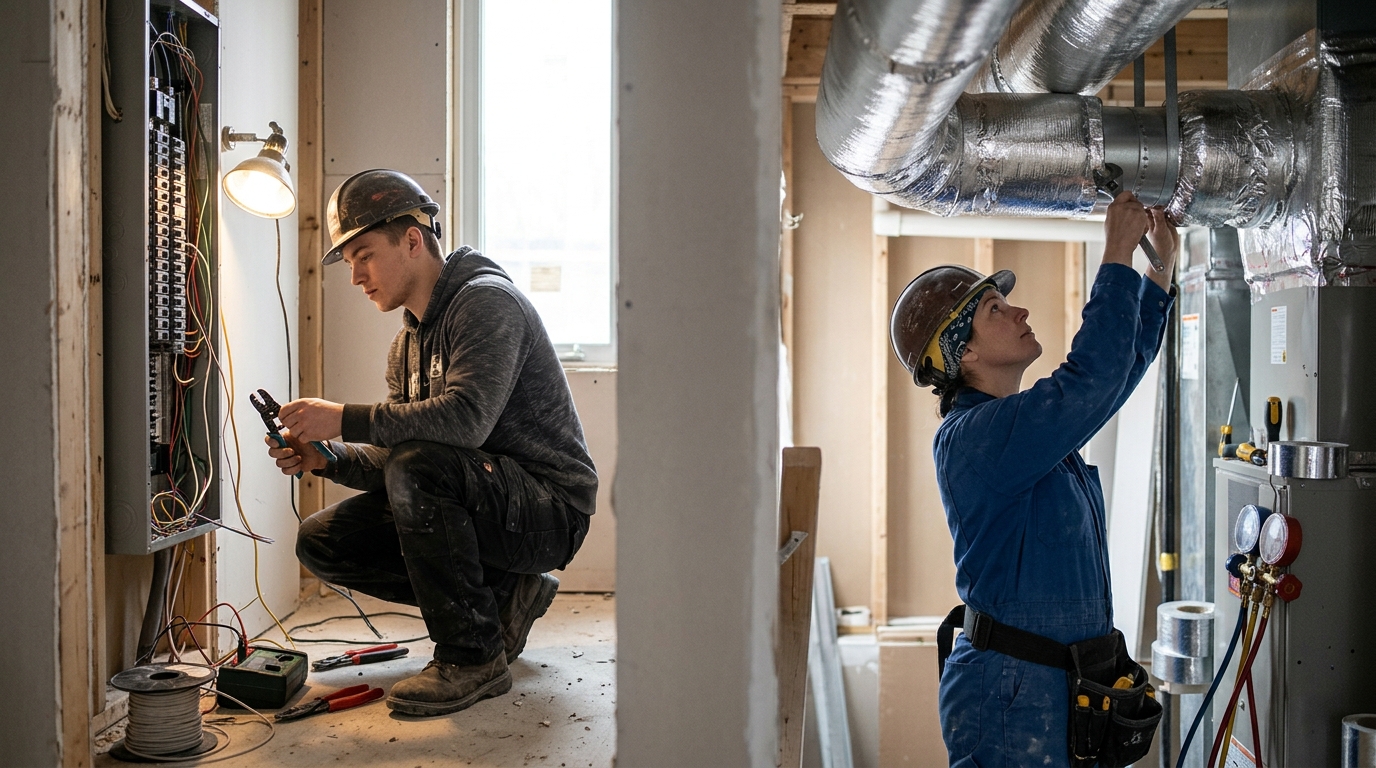
Electricians and HVAC technicians both install and service building systems, both are licensed or certified in some form, and their median pay is close: $63,190 a year for electricians and $61,010 for heating, air conditioning, and refrigeration mechanics and installers (U.S. Bureau of Labor Statistics, 2025). The real difference for a career changer is the route in — a 4- or 5-year electrical apprenticeship that pays you while you learn, versus a 6-month to 2-year HVAC program you usually pay for up front (U.S. Bureau of Labor Statistics, 2025).
This guide compares the two on entry requirements, tasks, hours, physical demands and outlook, then maps which prior careers hand you a head start in each.
Side-by-Side Comparison
| Dimension | Electrician | HVAC technician |
|---|---|---|
| Typical entry-level education | High school diploma or equivalent (U.S. Bureau of Labor Statistics, 2025) | Postsecondary nondegree award — a certificate or associate's degree (U.S. Bureau of Labor Statistics, 2025) |
| Main training route and length | 4- or 5-year apprenticeship, about 2,000 hours of paid on-the-job training a year plus technical instruction (U.S. Bureau of Labor Statistics, 2025) | Trade school or community college programs that generally last from 6 months to 2 years (U.S. Bureau of Labor Statistics, 2025) |
| Licence or certification | Most states require passing a licensing test covering the National Electrical Code and state and local electrical codes (U.S. Bureau of Labor Statistics, 2025) | EPA requires nearly all technicians to be certified in refrigerant handling; Section 608 has four types — Type I, Type II, Type III and Universal (U.S. Environmental Protection Agency, 2015) |
| Median pay, 2025 | $63,190 a year, or $30.38 an hour (U.S. Bureau of Labor Statistics, 2025) | $61,010 a year, or $29.33 an hour (U.S. Bureau of Labor Statistics, 2025) |
| Day-to-day tasks | Read blueprints, install and maintain wiring, control and lighting systems, inspect components such as transformers and circuit breakers, and follow the National Electrical Code (U.S. Bureau of Labor Statistics, 2025) | Install, maintain and repair heating, ventilation, air conditioning and refrigeration systems, install electrical components and wiring, test systems, and discuss malfunctions with customers (U.S. Bureau of Labor Statistics, 2025) |
| Schedule and hours | Almost all work full time; schedules may include evenings and weekends, and overtime is common (U.S. Bureau of Labor Statistics, 2025) | Most work full time; evening or weekend shifts, on-call emergency work and irregular schedules during peak heating and cooling seasons (U.S. Bureau of Labor Statistics, 2025) |
| Physical demands and conditions | Occasional work in cramped spaces and at great heights; long periods of standing and kneeling can be tiring (U.S. Bureau of Labor Statistics, 2025) | Often awkward or cramped spaces, and buildings that are uncomfortable because the heating or cooling system has failed; one of the highest injury and illness rates of all occupations, with burns and muscle strains from heavy equipment (U.S. Bureau of Labor Statistics, 2025) |
| Size of the field and outlook | About 821,000 jobs in 2025; employment projected to grow 9 percent from 2025 to 2035, with roughly 72,700 openings a year (U.S. Bureau of Labor Statistics, 2025) | About 440,900 jobs in 2025; employment projected to grow 11 percent from 2025 to 2035, with roughly 40,600 openings a year (U.S. Bureau of Labor Statistics, 2025) |
Two things the table cannot settle for you:
- Pay in your state and for your employer. The figures above are national medians for all workers in each occupation, apprentices and 20-year veterans alike. Union versus non-union shops, residential service versus industrial construction, and commission on equipment sales in HVAC all shift what lands in your paycheck. Check current local figures in the Bureau of Labor Statistics occupational wage data for your metro area before you commit to a programme.
- Licensing rules. Electrician licensing is set state by state and sometimes city by city, so look up your own state's electrical licensing board for the hour requirements and exam content. The refrigerant certification side is federal: Section 608 Type I, II, III or Universal from the U.S. Environmental Protection Agency, with the exam typically built into an HVACR programme (U.S. Bureau of Labor Statistics, 2025).
Who Tends to Thrive in Each
The person who does well as an electrician usually arrives with tolerance for a long, structured runway and comfort with code books. If you have come from the military, from commercial construction labour, or from a low-voltage or network cabling role where you pulled cable through plenum and read riser diagrams, the 4- or 5-year apprenticeship format will feel familiar rather than punishing — you are earning across roughly 2,000 hours of on-the-job training a year while classroom nights cover theory (U.S. Bureau of Labor Statistics, 2025). The daily work rewards people who like exactness over improvisation: blueprint takeoffs, bending conduit to a measured offset, terminating a panel so every circuit is labelled, and defending that work against a National Electrical Code inspection (U.S. Bureau of Labor Statistics, 2025). The licensing exam is a book exam on the National Electrical Code plus state and local rules (U.S. Bureau of Labor Statistics, 2025), so if studying for a written test after a full work day sounds intolerable, weigh that honestly.
The person who does well as an HVAC technician tends to be a diagnostician who also likes talking to customers. A former auto or diesel mechanic already thinks in pressures, temperatures and refrigerant cycles; swapping a manifold gauge set and vacuum pump for engine diagnostics is a short conceptual jump, and the 6-month to 2-year programme route means you can be testing systems in the field far sooner than the electrical apprenticeship allows (U.S. Bureau of Labor Statistics, 2025). The job includes explaining a malfunction to the homeowner standing beside you (U.S. Bureau of Labor Statistics, 2025), which suits people who came from service-counter, field service or retail management work. Be clear-eyed about two conditions: peak summer and winter bring on-call emergency work and irregular schedules (U.S. Bureau of Labor Statistics, 2025), and the occupation has one of the highest injury and illness rates of all occupations, with burns from brazing and muscle strains from lifting condensers (U.S. Bureau of Labor Statistics, 2025).
Transferable Skills by Background
- Auto or diesel mechanic — leans HVAC technician. You already read pressure and temperature together to find a fault, and you have used recovery equipment or at least an A/C service machine on vehicle systems. That maps straight onto evacuating a system with a vacuum pump, charging to a target subcooling, and the EPA Section 608 refrigerant-handling certification that nearly all HVAC technicians must hold (U.S. Environmental Protection Agency, 2015; U.S. Bureau of Labor Statistics, 2025). The 6-month to 2-year programme largely formalises diagnostic habits you have (U.S. Bureau of Labor Statistics, 2025).
- IT network or low-voltage cabling technician — leans electrician. Pulling and dressing cable, reading floor plans and riser diagrams, and working off a device schedule are the same motions as rough-in wiring. You will still start the 4- or 5-year apprenticeship near the bottom, but the blueprint reading and conduit-route planning in the first year will not be new (U.S. Bureau of Labor Statistics, 2025).
- Appliance repair or field service technician — leans HVAC technician. Your strongest asset is the customer conversation at the end of the call: explaining what failed, what it costs and what happens next. That is a named part of the HVAC job description — discussing malfunctions with customers (U.S. Bureau of Labor Statistics, 2025) — and residential service companies hire for it. Sealed-system refrigeration work on refrigerators also overlaps with Type I small-appliance certification (U.S. Environmental Protection Agency, 2015).
- Military or commercial construction labourer — leans electrician. Two transfers matter here: working from printed plans to a tolerance, and sustaining a multi-year training pipeline with testing at each stage. The apprenticeship's roughly 2,000 paid hours a year plus night classroom instruction (U.S. Bureau of Labor Statistics, 2025) resembles a service training schedule, and the site conditions — cramped spaces, work at height, long stretches of standing and kneeling (U.S. Bureau of Labor Statistics, 2025) — will not surprise you.
Whichever way you lean, make the next step concrete rather than aspirational: contact your state electrical licensing board for the exact on-the-job hour count it requires, and ask two local HVACR programmes whether their 6-month to 2-year course includes the EPA Section 608 exam, what it costs in total, and whether evening sections let you keep your current job while you study.
Frequently asked questions
Which pays more, an electrician or an HVAC technician?
At the national median, electricians are slightly ahead: $63,190 a year, or $30.38 an hour, versus $61,010 a year, or $29.33 an hour, for heating, air conditioning, and refrigeration mechanics and installers in 2025 (U.S. Bureau of Labor Statistics, 2025). That gap of roughly $2,180 a year is small enough that your state, your employer and your overtime hours will matter more than the occupation you pick. Both occupations commonly include overtime (U.S. Bureau of Labor Statistics, 2025), so look up the wage data for your own metro area rather than the national figure.
How much faster can I start working as an HVAC technician?
HVAC programmes generally last from 6 months to 2 years and lead to a certificate or associate's degree, while most electricians learn through a 4- or 5-year apprenticeship (U.S. Bureau of Labor Statistics, 2025). In the fastest case that is a difference of about three and a half years before you are fully qualified. The trade-off is that the electrical apprenticeship pays you across roughly 2,000 hours of on-the-job training each year, whereas HVAC school is usually tuition you pay before earning.
Which field has more job openings?
Electricians hold the larger field — about 821,000 jobs in 2025 against about 440,900 for HVAC technicians — and about 72,700 electrician openings are projected each year on average, compared with about 40,600 HVAC openings (U.S. Bureau of Labor Statistics, 2025). HVAC is growing at the faster rate, 11 percent from 2025 to 2035 versus 9 percent for electricians (U.S. Bureau of Labor Statistics, 2025), but electricians still show more openings in absolute terms each year.
Do I need a licence for both, and are they the same kind of credential?
No. Most states require electricians to pass a licensing test covering the National Electrical Code and state and local electrical codes, so the rules are set where you live (U.S. Bureau of Labor Statistics, 2025). For HVAC, the core credential is federal: the U.S. Environmental Protection Agency requires nearly all technicians to be certified in refrigerant handling, under one of four Section 608 types — Type I for small appliances, Type II for high-pressure, Type III for low-pressure and Universal for all three (U.S. Environmental Protection Agency, 2015). Many states and cities add their own HVAC contractor licence on top, so check your state board as well.
Sources
- U.S. Bureau of Labor Statistics — Electricians : Occupational Outlook Handbook (2025)
- U.S. Bureau of Labor Statistics — Heating, Air Conditioning, and Refrigeration Mechanics and Installers : Occupational Outlook Handbook (2025)

Written by
Tobias Lindqvist
Tobias writes on trades, apprenticeships, and the kinds of careers that don't start with a resume. He's interested in skill as a form of dignity, and in how little the discourse around work usually accounts for hands.